


With 468 out of 480 deputies voting in favor on November 21, the National Assembly passed a 10-year resolution introducing special mechanisms and policies for Vietnam's tourism development starting in 2027.
Prior to the vote, Minister of Culture, Sports and Tourism Lam Thi Phuong Thanh presented a report on the draft resolution, which identifies priority zones including tourism growth poles, tourism centers, national tourist areas, and sites with potential for national tourist area status under the national tourism system master plan.
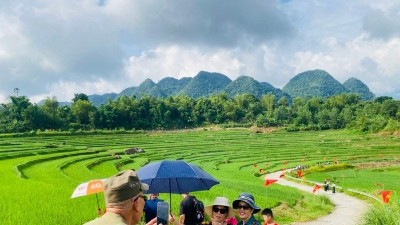
Notably, the policy targets community-based tourism sites across ethnic minority regions, mountainous areas, islands, border zones, rural communities, and economically disadvantaged areas, with support and incentives scaled progressively according to project criteria.
Another pillar of the resolution supports business development and community linkages, including incentives to open new tourism air routes and promote the sustained consumption of One Commune, One Product (OCOP) goods. For emerging business models, the resolution provides targeted support for community-involved tourism services, the sharing economy, digital platform operations, the nighttime economy, and riverine and coastal tourism.
Integrated products combining tourism with entertainment, culture, sports, healthcare, and medical treatment are also backed alongside digital technology and virtual reality applications. Notably, large-scale integrated music venues and entertainment streets are permitted to operate 24/7.
According to Minister Lam Thi Phuong Thanh, these provisions bring a wide range of new business models and spaces under special policy frameworks, including nighttime, riverine, and coastal economies as well as multi-sector service complexes.
On workforce development, the resolution allocates funding to train high-quality personnel and specialists in innovation, digital transformation, digital content creation, foreign languages, vocational skills, and tourism management, while prioritizing local labor in community tourism areas, including rural workers, ethnic minorities, and cooperative members.
Overall, the newly adopted framework covers key pillars from investment attraction, air route expansion, product innovation, and workforce training to visa facilitation and infrastructure, with community tourism supported through priority zoning, local training, and supplemental local budget allocations.
Building on this policy push, the Ministry of Culture, Sports and Tourism has urged localities to review targets, update growth scenarios, and focus on high-volume nearby markets such as Northeast Asia, Southeast Asia, India, and the broader Asia-Pacific region, developing competitive packages anchored by nighttime tourism and shopping to boost visitor spending.
Since November, localities and businesses have accelerated winter product renewal and regional linkages. In Mui Ne (Lam Dong), The Anam resort launched its Windswept Adrenaline adventure tour, turning the northeast monsoon season from November 2026 to March 2027 into a draw with Jeep rides across Hon Rom beach, kitesurfing lessons on the Ca Ty River, and sunset parties.
In the north, Hai Phong and Quang Ninh proposed the "Two localities, one destination" initiative, linking the historic port city's urban heritage with Ha Long Bay, Cat Ba, and Yen Tu to attract international film crews. Meanwhile, Hanoi rolled out 23 new tourism products spanning rail journeys, heritage tours, cuisine, night experiences, and wellness for the Christmas and New Year season.
In central Vietnam, Da Nang is linking the Hoi An and My Son heritage corridor with Cham relics and historical revolutionary sites, while investing in 37 mountainous ethnic minority communes (home to roughly 164,000 Co Tu, Gie Trieng, Xo Dang, Ca Dong, and Co residents) to develop community and eco-tourism products. In its southern area, the city aims to launch 12 to 15 new routes between 2026 and 2030, spotlighting Loc Yen ancient village, the Truong Giang River, Phu Ninh Lake, and Tam Hai Island.
In the south, Ho Chi Minh City is expanding its year-end offerings. Alongside upgraded nighttime economy zones across Ben Thanh, Saigon, Cho Lon, and Phu Nhuan wards, visitors can take helicopter sightseeing tours or enjoy dining, live music, and fireworks aboard dinner cruises on the Saigon River. Extending toward Vung Tau's coastline, resort offerings now include sunset sea tours and night food walks, while the Con Dao Special Zone highlights green tourism experiences such as sea turtle conservation, hatchling releases, and coral planting dives.
Concurrently, Newstar Tour officially launched its 39-day, 38-night Trans-Vietnam Tour with daily departures for individual travelers, connecting destinations across the north, central coast, Central Highlands, south, and Mekong Delta. Rather than limiting guests to a fixed itinerary, the operator divided the journey into five segments comprising more than 60 customizable shorter tours.
Mr. Nguyen Quy Phuong, Director of the International Relations and Tourism Promotion Department under the Vietnam National Authority of Tourism, noted that national policies increasingly emphasize product innovation, technology adoption, smart tourism, and elevated visitor experiences, requiring businesses to proactively research and create new offerings tailored to shifting market demand.


 Google translate