



A new industry benchmark from Hashmeta AI showed that Vietnamese brands are gaining ground in the emerging AI-driven discovery market, accounting for 51.1 per cent of 2.14 million citations in Vietnamese AI answers. Yet the field remains fragmented and highly concentrated, with publishers and foreign platforms taking a substantial share and a small group of brands capturing a disproportionate amount of visibility.
The Vietnam AI-Visibility Industry Benchmark 2026 examined 390 brands across 20 industries, including 282 Vietnamese brands alongside foreign brands and platforms competing for the same AI-generated answers. Rather than measuring conventional Google rankings, the report tracks how frequently brands are cited in Vietnamese AI answers, using SEMrush data for Vietnam and four AI engines: ChatGPT, Gemini, Google AI Overviews, and Google AI Mode.
The findings pointed to an increasingly important shift in how consumers may discover brands. AI answer engines do not simply return a list of search results. Rather, they select a limited number of sources to support their answers. In this environment, being visible means being among the sources an AI system chooses to cite.
Race to be seen
Across the 390-brand cohort, Vietnamese brands accounted for 51.1 per cent, or 1.095 million, of the 2.14 million Vietnamese AI citations recorded in the benchmark. Vietnamese publishers accounted for another 25 per cent, while foreign platforms captured 19.4 per cent and foreign brands 4.5 per cent.
The result puts Vietnamese brands ahead of every other category, but the report describes the market as a “contested answer” rather than a space dominated by local companies. Vietnamese brands hold the largest share, while foreign brands and platforms together account for 23.9 per cent of citations.
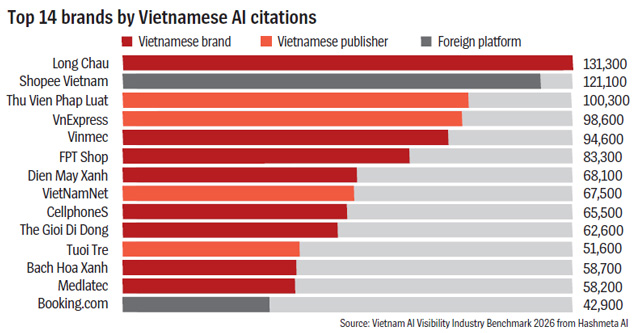
The distribution is also concentrated among a relatively small number of domains. Long Chau led the overall rankings with 130,300 citations, followed by Shopee Vietnam with 121,100 and Thu Vien Phap Luat with 100,300. VnExpress ranked fourth with 98,600, followed by Vinmec with 94,600 and FPT Shop with 83,300.
Other leading names include Dien May Xanh, VietNamNet, CellphoneS, The Gioi Di Dong, Tuoi Tre, Bach Hoa Xanh, MEDLATEC, and Booking.com. Together, the Top 3 account for 16 per cent of citations, illustrating how heavily AI answers can cluster around a limited number of established sources.
Long Chau is the strongest Vietnamese brand in the benchmark, with 130,300 citations and an AI Visibility score of 59. Vinmec followed with 94,600 citations, while FPT Shop recorded 83,300. Dien May Xanh, CellphoneS, and The Gioi Di Dong also ranked among the strongest local brands.
The Vietnamese field extended beyond the leading names. Bach Hoa Xanh had 50,700 citations, MEDLATEC 50,200, Pharmacity 37,400, and Tam Anh Hospital 33,600. The figures show that AI visibility is not confined to a single industry, though some sectors have accumulated considerably more citations than others.
Retail and e-commerce is the largest industry in the benchmark, with 20 brands generating 536,695 citations. Healthcare and medical followed with 417,217, while media and entertainment recorded 415,906. Hospitality and travel accounted for 238,342 citations, followed by professional and business services with 171,615.
The gap widened further down the rankings. The report identified one Vietnamese brand with zero measured citations and another 30 below the 50-mention threshold. Among those listed are VASCO, Saladin, OPES, Guo, VATM, The Coffee House, Vietnam Report, SPT, Bkav, and KIDO. The report stressed that a genuine zero, a below-threshold result, and a lack of data are different conditions and should not be treated as equivalent.
Gateway to AI visibility
The benchmark also showed that where AI visibility comes from matters as much as how much visibility a brand receives.
Google’s AI ecosystem accounted for 76 per cent of Vietnamese brand mentions measured in the report. AI Mode contributed 30.7 per cent, or 377,700 mentions, followed by Gemini at 28.5 per cent, or 350,200. ChatGPT accounted for 24.4 per cent, or 299,600, while Google AI Overviews contributed 16.4 per cent, or 201,900.
The figures make Google’s three measured AI surfaces - AI Mode, Gemini, and AI Overviews - the dominant source of Vietnamese AI mentions in the benchmark. ChatGPT remains significant, but optimizing for ChatGPT alone would address only 24 per cent of the mentions captured in the report.
The report’s methodology is deliberately limited to the four engines for which SEMrush provides Vietnam-level coverage. Perplexity and Copilot return no data at the Vietnam scope, and the report explicitly says this represents a coverage gap rather than zero visibility.
This distinction is important because the benchmark is designed to measure actual citations rather than the broader 0-100 AI Visibility score. According to the report, the score represents a share index of a domain’s own footprint and should not be used as a ranking. A brand can have a “Medium” score despite having only a few hundred Vietnamese mentions, while another brand can have a similar score with substantially more mentions.
The report therefore ranked brands according to citations - the number of times an AI answer actually points to a brand’s pages in Vietnam. This approach is intended to distinguish actual visibility in AI answers from a broader index of a domain’s digital footprint.
Power of authority
The benchmark found a strong relationship between a brand’s established search presence and its visibility in AI answers. The correlation between SEMrush Authority Score and Vietnamese AI citations is 0.74, indicating that brands with deeper search footprints also tend to receive more AI citations.
The report described this relationship as something built over time rather than through a single campaign. The brands with the strongest search presence are also among those most frequently cited by AI systems.
At the same time, the report’s findings pointed to a particular type of content that can help brands become more visible: structured, extractable answers to questions consumers actually ask.
Its proposed CITE framework starts with “Create decision content” - publishing information such as prices in VND, branch locations, requirements, and comparisons rather than relying on conventional brand-focused pages. The second element, “Involve entity proof,” emphasizes Google Business Profiles, Wikipedia, and Wikidata, reviews, and Vietnamese listings as signals that AI systems cross-check.
The third element is to “Target Google’s stack,” reflecting the 76 per cent share of Vietnamese mentions attributed to Gemini, AI Mode, and AI Overviews. The report recommends schema and snippet-shaped answers as part of this approach. The final element, “Earn the answer layer,” focuses on gaining mentions on aggregators and publishers that AI systems already cite within a category.
The report translated this framework into a first 90-day plan. It recommends first auditing the citation gap by identifying the prompts relevant to a brand’s category and recording which domains AI systems currently cite. Brands can then publish pages addressing missing questions, with specific information such as pricing, locations, and eligibility that AI can extract directly.
The next step is to strengthen the brand’s entity record by completing Google Business Profiles, Wikidata, and Vietnamese directories, while also seeking inclusion on aggregators, publishers, and “best of” lists already cited by AI systems.
The benchmark ultimately presents AI visibility as a new layer of brand discovery built on top of an existing digital footprint. Vietnamese brands already account for more than half of the citations measured in their home market, but the answer space is still shared with publishers, foreign platforms, and foreign brands - and heavily concentrated among a small group of established sources.
For brands outside that leading group, the report’s central message is not simply to generate more content. It is to create information that can be extracted as an answer, strengthen the signals that establish what the brand is, and become present on the third-party sources that AI systems already trust and cite.
The benchmark is based on SEMrush AI SEO Overviews and Domain Overviews data captured on September 27, 2026, using the Vietnam database. It covers 390 brands across 20 industries, with Vietnamese brands, foreign brands, Vietnamese publishers, and foreign platforms measured separately.






 Google translate