


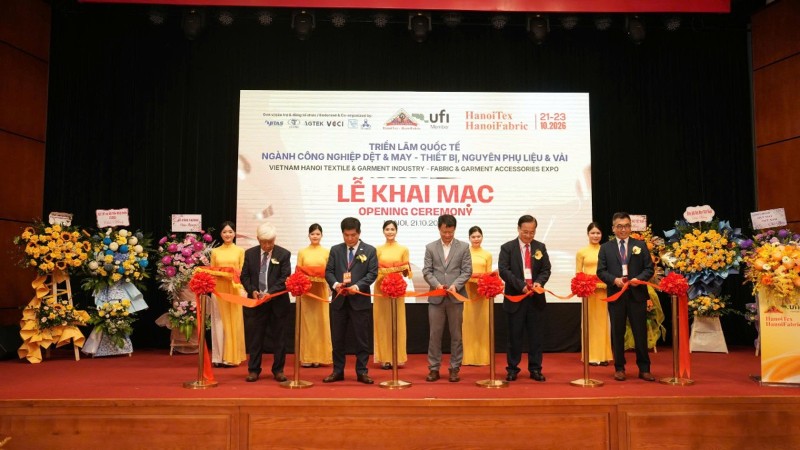
At the opening of the Vietnam Hanoi Textile & Garment Industry - Fabrics & Garment Accessories and Expo (HanoiTex & HanoiFabric) on October 21 in Hanoi, it was highlighted that developing environmentally compliant spinning, weaving, dyeing, finishing, and domestic accessory production is an urgent requirement for Vietnam’s textile and garment enterprises to leverage free trade agreements (FTAs) and secure order stability.
Speaking at the event, Mr. Pham Van Quan, Deputy Director General of the Industry Agency under the Ministry of Industry and Trade, stressed that textiles remain a key export sector and major job creator.
In 2025, the industry's export turnover reached nearly $46.2 billion, up 6 percent from 2024, with a trade surplus exceeding $20.7 billion. Vietnam maintained its position among the world’s top three textile exporters, achieving a 52 percent value-added rate for exported products.
In the first nine months of 2026, export turnover reached over $36.4 billion, up 3.2 percent year-on-year. Notably, exports of yarn and fiber rose 13.1 percent, while textile, garment, leather, and footwear accessories grew 9.4 percent.
However, Mr. Quan pointed out that the industry still relies heavily on imported raw materials, concentrating primarily on processing with modest value addition. Meanwhile, major import markets are tightening requirements regarding green production, supply chain transparency, traceability, and rules of origin.
Additionally, under the EU’s Ecodesign for Sustainable Products Regulation and upcoming digital product passports, localized raw material production has become vital for FTA utilization.
To adapt, Mr. Quan urged enterprises to standardize data on materials, energy, and origin, build supply chain risk maps, and enhance localization rates. He also called for cross-sector collaboration with mechanical, electronic, and digital technology industries, alongside practical AI applications in demand forecasting, pattern design, fabric defect inspection, and production scheduling.
Echoing this view, Mr. Vu Duc Giang, Chairman of the Vietnam Textile and Apparel Association (VITAS), affirmed that new-generation FTAs and automation, robotics, and AI offer foundation for long-term growth.
Events like HanoiTex & HanoiFabric help connect businesses with investors across spinning, weaving, dyeing, and garment sectors to form integrated domestic supply chains, unlocking origin rule benefits, he added.
From a corporate perspective, Mr. Cao Huu Hieu, CEO of Vietnam National Textile and Garment Group (Vinatex), reported a 7 percent year-on-year export growth in the first nine months of 2026. Looking ahead to 2027 amid global geopolitical and trade uncertainties, he emphasized investing in digitalization, AI, and deep production efficiency to expand capacity and boost product value.
HanoiTex & HanoiFabric 2026 runs from October 21 to 23 at the I.C.E Hanoi Exhibition Center, featuring over 250 booths from eight countries and territories, including China, Hong Kong (China), Taiwan (China), Japan, India, Indonesia, South Korea, and Vietnam.
The event showcases digital automation, green manufacturing solutions, and comprehensive supply chains, expecting to welcome over 10,000 professional visitors.






 Google translate