


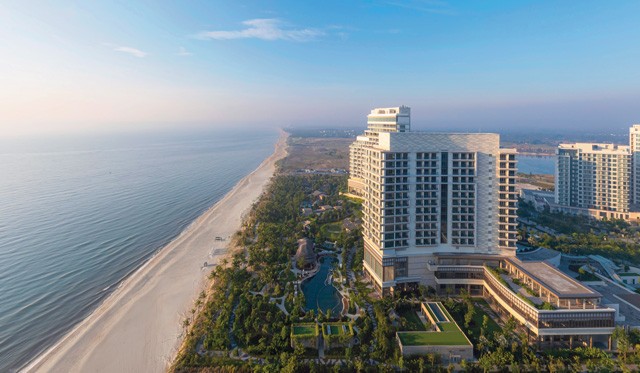
Vietnam’s resort real estate market is changing from a race to expand supply toward building destinations, optimizing operations, and diversifying experiences. Developers are seeking to connect real estate with aviation, entertainment, hotels, retail, and services to create ecosystems that can operate more sustainably.
At the Meet the Experts conference (MTE Hanoi 2026), experts said Vietnam’s real estate and resort market is seeing growing interest in large-scale integrated developments. Developers with strong financial resources and experience in phased project development are moving beyond accommodation alone, combining hotels, second homes, retail, entertainment, and public spaces to create attractive destinations with diverse service ecosystems that can draw visitors.
This reinforces the market’s shift into a new phase of development, in which a project’s appeal is no longer determined solely by its location or product scale. Connectivity, visitor access, accommodation, entertainment, operations, and destination identity are becoming increasingly interconnected.
Building destinations
For the Sun Group, aviation is a key link in its strategy to develop destinations. Mr. Daniel Trinh, Deputy Chief Commercial Officer and Chief Business Development Officer, said the group currently operates across five sectors: entertainment, hospitality, healthcare, real estate, and aviation. Aviation is a challenging business, requiring significant capital, carrying high fuel costs, and facing considerable volatility. However, the Sun Group does not view it as a standalone business, but rather as a tool to create and expand destinations.
Its strategy often starts in underdeveloped areas rather than focusing solely on Hanoi or major cities. Infrastructure comes first in this process. The company has participated in airport infrastructure development, operated existing terminals, developed new terminals, and invested in light rail and supporting infrastructure. Importantly, these projects are not intended to serve Sun Group’s developments alone. Once infrastructure is in place, other businesses can also participate and tap into the destination’s potential. In this way, an initial infrastructure investment can create room for a broader range of business activities to develop.
The Masterise Group, meanwhile, has also expanded from a real estate developer into a broader range of related sectors over the past two years, moving into hospitality, clubs, museums, aviation infrastructure, and logistics. Ms. Nelly Phuong Ta, Head Of Hospitality & Entertainment, said that between 2017 and 2025 the market saw products absorbed at a very rapid pace, with some projects selling out 500 units in just two days. As the market entered 2026, however, its recovery has been accompanied by a surge in new supply, with more than 50,000 apartments potentially coming to market. This is putting new demands on developers to find ways to ensure their products are actually used and provide better experiences for buyers.
“For Masterise, the goal is not simply to sell homes, but to reach people who genuinely intend to use them, while improving the overall experience and amenity system,” she said. “Real estate should not be viewed only at the point of transaction, but also in terms of its ability to create value throughout the period of use.”
At the T&T Group, the market is viewed through the lens of a diversified investment portfolio. The company operates in around 20 sectors, ranging from sports and green energy to entertainment, aviation retail, and other fields. Ms. Thu Le, CEO of T&T Hospitality, said operating across multiple industries gives investors a broader view of the market, helping them identify what is already available, what is still missing, and what customers actually need. For resort real estate, this perspective is particularly important because a project cannot be separated from the activities taking place around it. Visitors do not come to a resort simply to use a room or a property; they also seek services, experiences, entertainment, and other values offered by the destination.
The different approaches taken by these three groups show that the scope of a resort development is expanding in multiple directions. Aviation and infrastructure provide access, hotels, and services generate visitor flows, while entertainment, cultural activities, and additional amenities extend the overall experience. Real estate is therefore becoming one link in a broader chain of activities rather than the endpoint of development.
Access and operations
If infrastructure opens the way for a destination, the ability to bring in and maintain visitor flows directly determines the performance of resort products. The Radisson Hotel Group sees destination development as closely tied to accessibility. With hotels in Phu Quoc and other markets, increased flight connectivity allows the company to bring loyal guests to destinations. Radisson has a large network across Europe, India, and China, making air connectivity directly relevant to its ability to tap into these source markets.
However, Mr. Armand Steinmeyer, Vice President, Development, South East Asia, said improved accessibility and the arrival of more new projects would also intensify competition. New supply could put pressure on occupancy and room rates, while markets may go through absorption periods as new properties come online. In this context, he said affiliation with an international brand could help hotels access a more diverse customer base through established distribution networks and existing guest pools. In a market that is growing while also seeing additional supply, the ability to generate stable visitor flows has become an important part of the operational equation.
From a developer’s perspective, the Masterise Group is also facing a different supply challenge. After a period of rapid sales, the volume of new products expected to enter the market in 2026 is making absorption a more important consideration. Ms. Nelly said this is not an issue for any single developer, but a broader market challenge as supply increases.
Under these conditions, bringing a product to market is no longer the end point. The quality of the experience and amenities also matter. This is changing the role of operators. A project may have a strong location, high-quality investment, and significant scale, but without the right visitor flows or consistent operational quality, its initial advantages may be difficult to translate into long-term performance.
Flexible stays
As destinations and visitor profiles evolve, accommodation models are also becoming more diverse, requiring operators to adjust their products, design, and customer approach. The Ascott is a clear example. From a company specializing in serviced apartments, Ascott has expanded its portfolio to include multiple brands, including Somerset and Citadines, while also developing hotel models.

Real estate should not be viewed only at the point of transaction, but also in terms of its ability to create value throughout the period of use.

According to Ms. Venessa Koo, Vice President of Business Development at The Ascott Limited, the market is changing as travelers have more choices and do not always seek a traditional hotel product. In addition to families and short-stay leisure travelers, businesses need accommodation for relocated employees, while some guests require stays of one or two months, or even longer. Ascott is therefore moving toward a combination of short and long-stay accommodation rather than focusing on a single customer segment.
“This brings changes across multiple areas, from room design and amenities to service delivery, sales, and marketing,” Ms. Koo said. “A product designed for guests staying a few days has different requirements from one serving guests staying for weeks or months.”
Radisson, meanwhile, is focusing on localization as it expands across Asia. According to Mr. Steinmeyer, even within Southeast Asia, individual markets have different needs. As a result, applying the same model to every destination is not always appropriate. As destinations develop more projects and accommodation supply becomes more diverse, competitive advantages will no longer come simply from building a large property or a resort with extensive amenities. As a market develops, new supply will continue to increase, making competition for more pronounced.
The Ascott also views this process from an operator’s perspective. Destinations such as Phuket took around 20 years to develop through a combination of airports, infrastructure, and the participation of multiple stakeholders. Phu Quoc has also changed significantly over the past 15 years. Once primarily associated with fishing, the island has evolved into a tourism destination. This shows that a destination cannot be built in a short period and cannot be the result of a single project.
Once a destination is established, the next challenge is to maintain its appeal and create differentiation. T&T Group is turning to Vietnamese culture and architecture as part of its approach to product development. For its projects, the company aims to incorporate elements of local life into resort spaces, such as creating areas where fishing village activities can take place and local residents can live and work. According to the T&T Group, clearly defining a project’s identity and positioning from the outset therefore affects not only its design, but also the selection of partners and the way it will ultimately be operated.
As the resort real estate market shifts from a focus on project development toward greater emphasis on operational performance, the value of an asset will increasingly be tied to the value of the destination itself. As tourism becomes an increasingly important economic pillar, a project must do more than simply be built. It must connect with surrounding infrastructure, visitor flows, services, culture, and communities.

 Google translate