



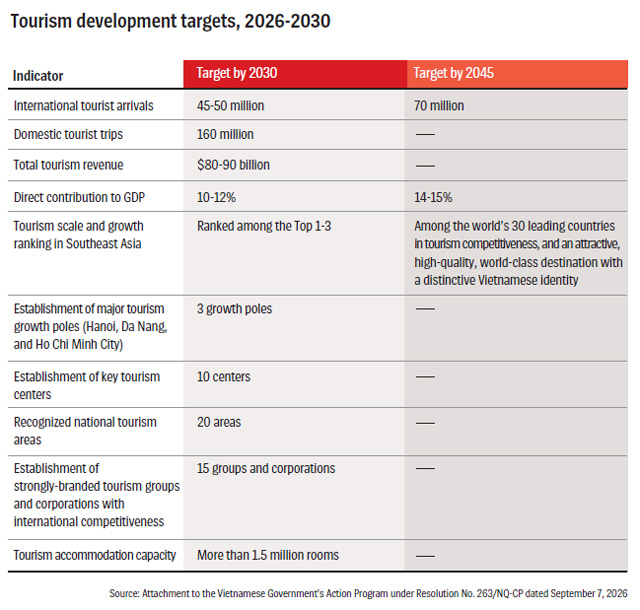
Politburo Resolution No. 26-NQ/TW dated August 22, 2026, on developing tourism into a leading economic sector in the new era, sets a potentially-transformative target for Vietnam’s tourism sector: by 2030, attracting 45-50 million international visitors, generating $80-90 billion in tourism revenue, and contributing 10-12 per cent directly to GDP. At the same time, tourism is to shift toward deeper, higher-quality, more efficient, and sustainable development that creates greater value-added, rather than focusing primarily on increasing visitor numbers.
This is an ambitious target given the sector’s current scale. Vietnam welcomed some 21.2 million international visitors in 2025, meaning that reaching 45 million by 2030 would require more than doubling international arrivals in just five years. In terms of compound annual growth rate (CAGR), Vietnam would need to sustain international visitor growth of around 16-19 per cent annually between 2025 and 2030; significantly above the average annual growth rate of 8-10 per cent previously set out in the tourism development strategy through 2030 issued in 2020.
The harder task is to generate $80-90 billion in tourism revenue at the same time. This requires not only attracting more visitors, but also encouraging them to stay longer, experience more, and use more services, while, most importantly, ensuring a larger share of their spending is retained as domestic value-added.
Four priorities
Vietnam’s target becomes even more challenging when viewed against the backdrop of regional tourism competition. Thailand, Malaysia, and Singapore are all continuing to adjust their strategies to attract higher-spending visitor segments, extend stays, and expand revenue streams beyond traditional accommodation.
Vietnam has a relatively clear advantage in safety and price competitiveness, but trails Thailand in important areas such as air transport infrastructure, openness, natural resources, non-leisure resources, and information and communications technology (ICT). Compared to Malaysia, the gaps extend to business environment, ICT, tourism prioritization, openness, air transport, ground infrastructure, and tourism services. This indicates that Vietnam’s competitive challenge cannot be addressed through destination promotion or lower prices alone.
In other words, as Vietnam strives to more than double international arrivals over the course of five years, its direct competitors will also be upgrading their products, infrastructure, and ability to attract visitors. The strategy through 2030 cannot therefore focus only on the question of “How can we attract more visitors?” It must answer the harder question: “Why would an international visitor who is considering Thailand, Malaysia, or Singapore choose Vietnam, stay longer, and spend more?”
From this perspective, four priorities should be placed at the center of the strategy.
Firstly, connecting destinations into new journeys through new infrastructure. Vietnam needs to shift from developing individual destinations toward creating destination networks capable of supporting longer journeys. This is particularly important as major transport infrastructure projects are already reshaping, and will continue to reshape, connectivity between tourism hubs.
By 2030, Vietnam’s tourism infrastructure could change significantly with the emergence and expanded role of key facilities such as Long Thanh International Airport, Gia Binh International Airport, and new urban and interregional rail lines, including the Ben Thanh - Can Gio line in Ho Chi Minh City and the high-speed railway project connecting Hanoi with Quang Ninh province. Once these infrastructure assets are effectively connected to existing hubs and destinations, Vietnam’s ability to organize and distribute tourism flows could expand significantly.
This also aligns with the direction set out in Politburo Resolution No. 26, which calls for an integrated tourism services ecosystem linking transport infrastructure with heritage centers, destinations, resort complexes, entertainment and recreation, shopping, food and beverages, performing arts, and the night-time economy. The next phase should therefore avoid treating infrastructure and tourism products as separate development tracks and instead design them together.
Secondly, connecting individual services into a complete tourism value chain. Politburo Resolution No. 26 clearly calls for stronger value chain links between travel services, transportation, accommodation, services, and local products, to increase domestic value-added, improve overall economic efficiency, and enable Vietnamese businesses to participate more deeply in global value chains, distribution channels, and tourism-related exports. This represents an important shift in thinking: tourism should not be viewed simply as a hotel, travel, or sightseeing industry, but as an economic ecosystem connecting multiple sectors.
This is also why Politburo Resolution No. 26 emphasizes not only coastal and cultural tourism products but also MICE (Meetings, Incentives, Conferences, and Exhibitions) tourism, shopping, medical tourism, wellness, education, entertainment, and the night-time economy within the same product ecosystem, while calling for higher service quality across the entire tourism value chain. The ultimate goal is to connect these products into a complete experience.
Thirdly, creating hard-to-replicate competitive advantages. Vietnam, however, still needs a clearer answer on brand differentiation. If it develops only the same products that destinations across the region are pursuing - beach resorts, MICE, shopping, wellness, nightlife, and luxury tourism - it will face increasingly direct competition from countries with stronger established brands.
Vietnam’s advantage lies in its ability to combine a range of resources that few destinations possess simultaneously: beaches and islands, cultural heritage, history, nature, cuisine, community life, and rapidly-developing cities. Politburo Resolution No. 26 also identifies culture, heritage, natural landscapes, and cuisine as distinctive advantages that should be connected to key markets and products, with quality, identity, and differentiated experiences serving as the basis for competition.
The key is to turn these resources into products that visitors can purchase and experience, rather than leaving them simply as underlying assets. Politburo Resolution No. 26 points in this direction by encouraging the integration of cultural tourism with film, music, entertainment, fashion, digital technology, the creative economy, and the night-time economy, while developing signature national products and cultural-tourism value chains capable of competing internationally.
Fourthly, retaining more value in the Vietnamese economy. The $80-90 billion target must also be accompanied by an increase in the share of value retained within the domestic economy. This requires expanding local spending across accommodation, transportation, food and beverages, shopping, entertainment, and experiential services. Politburo Resolution No. 26 also identifies logistics, duty-free shopping, food and beverages, entertainment, performing arts, the night-time economy, and premium services as areas for development, while calling for stronger value chain links to increase domestic value-added.
Another issue is distribution. Vietnamese businesses, particularly small hotels, accommodation providers, and travel companies, need greater ability to sell directly to international visitors, control customer data, and accept international payments, rather than relying too heavily on intermediary platforms. The national digital tourism platform should therefore focus on connecting data, payments, and business sales capabilities rather than building another booking app to compete directly with international online travel agencies (OTAs).
Overall, the tourism strategy through 2030 is built around a strategic shift from “selling destinations” to “selling journeys.” New infrastructure must create new journeys; destinations must be connected into networks; businesses must be linked through value chains; cultural, natural and culinary resources must be transformed into hard-to-replicate experiences; while technology, value-added tax (VAT) refunds, shopping, payments, and distribution platforms must serve as tools to help Vietnamese businesses retain more of the value generated by visitors.



 Google translate