


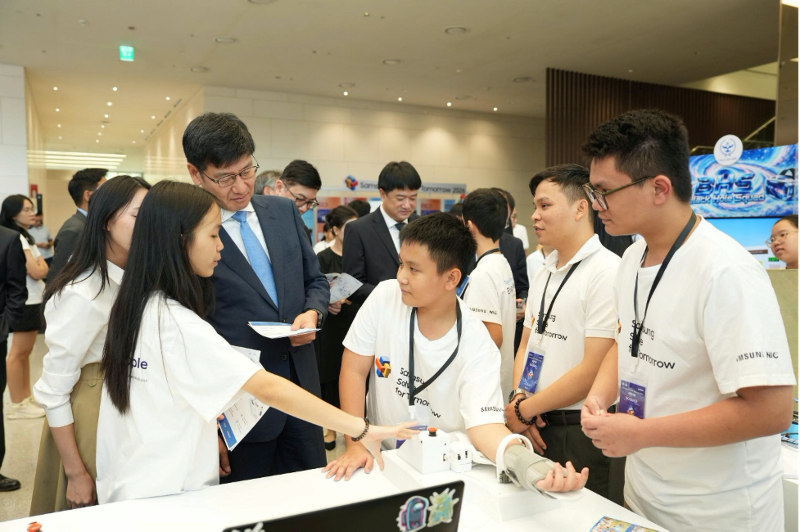
"Samsung Solve for Tomorrow 2026" is a competition which promotes STEM education while expanding opportunities for students to apply technology to real-world issues.
In late October 2026, 17 outstanding teams participated in the final round, presenting technological solutions in education, health, environment, and sustainable development.
The competition received entries from students across more than 1,800 secondary and high schools nationwide, representing the highest number of ideas since its local inception in 2019. The outcome highlights the impact of the collaboration model linking government bodies, enterprises, and educational institutions in advancing STEM training.
Expanding the competition's reach is a key partnership between Samsung Vietnam and the National Innovation Center (NIC) under the Vietnamese Ministry of Finance. The initiative connects Samsung's technological resources and educational experience with NIC's innovation ecosystem, giving students access to specialized knowledge, skills, and hands-on technology experiences.
Mr. Na Ki Hong, General Director of Samsung Vietnam, stated that combining Samsung's technological resources with NIC's network helps foster an innovation ecosystem, expanding learning opportunities for Vietnamese students. Samsung plans to continue collaborating with NIC, educators, and schools to support student-led technological development.
Mr. Hoang Trung Hieu, Deputy Executive Director of NIC, affirmed that both parties will expand STEM and artificial intelligence training alongside specialized courses across more schools. NIC aims to connect experts to assist outstanding projects with product refinement, practical applicability, and potential commercialization.
The collaboration exemplifies a tri-party model where government entities link the innovation ecosystem, businesses contribute technology and expertise, and schools directly guide student projects.
Projects at the Samsung Solve for Tomorrow 2026 final round originated from specific real-life challenges, focusing on supporting vulnerable groups and advancing sustainable production.
In Category A for secondary school students, the NOVARISE team from Da Nang won first prize with their project "Rehab Play Arm - Robotic Arm Splint for Therapy," designed to assist children with hand movement difficulties. The solution integrates a robotic arm splint, interactive games, and an online management system. The device supports elbow movements, while gamified features keep children engaged during rehabilitation.
The online platform connects patients with physicians to enable remote tracking of rehabilitation progress. The team aims to develop a low-cost product suitable for domestic conditions. According to Mr. Nguyen Thanh Tu, the team's mentor, the project guided students through microcircuit design, 3D modelling, and technology product development. Following the competition, NOVARISE plans to refine product features, fulfill legal requirements, and conduct field testing toward commercialization.
In Category B for high school students, the CDTD team from Can Tho secured first prize with "CDGuard: An AI-IoT system for early warning of available Cadmium risk and decision support for durian soil remediation in the Mekong Delta."
The project combines smart devices and digital applications to monitor agricultural environments and warn of soil cadmium risks, assisting farmers with orchard management and sustainable farming practices.
Duong Hoang Thien Dang, a member of the CDTD team, noted that the group plans to refine the model, expand research to other crops, and deploy the system in field trials. The project enabled team members to gain practical experience in AI, programming, electronics, and robotics.
From rehabilitation devices to AI applications in agriculture, student projects at Samsung Solve for Tomorrow 2026 demonstrate practical applications of STEM knowledge to address community challenges. Supported by the public-private-academic partnership model, Vietnamese students continue to develop technology skills, refine products, and transition innovations into practical use.




 Google translate