


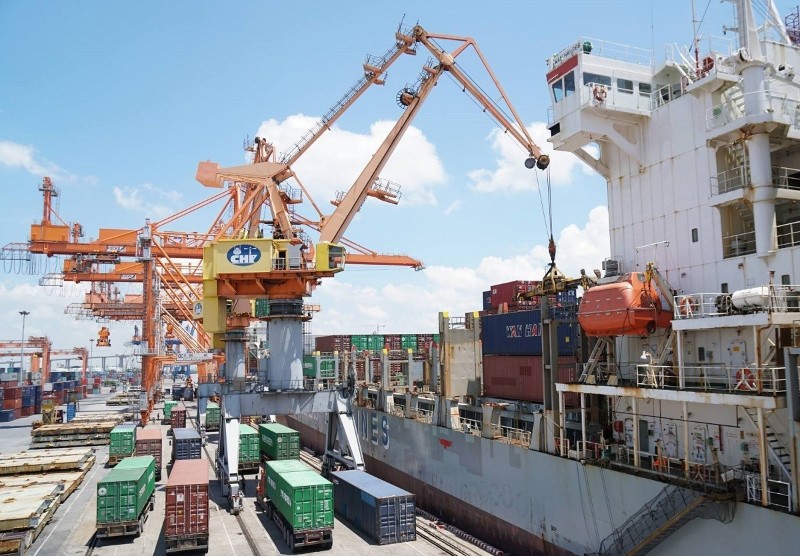
These insights were shared at the Impact Investment Forum titled “Unlocking Trade and Supply Chains,” hosted by the Investment and Trade Promotion Center of Ho Chi Minh City (ITPC), in partnership with the Impact Investment Exchange (IIX) and the Canadian Chamber of Commerce in Vietnam (CanCham), in Ho Chi Minh City on November 18, with support from the Government of Canada and the Impact Investment Readiness Vietnam (IIRV) project.
Citing data from the National Statistics Office under the Ministry of Finance released in early October 2026, Mr. Robert Kraybill, Chief Investment Officer at IIX, noted that domestic enterprises’ share of Vietnam’s total exports fell from 27.9 percent in 2024 to 24.5 percent in 2025, and further down to 19.3 percent in the first nine months of 2026.
While national exports surged 24.5 percent year on year to $434.3 billion during the nine-month period, the domestic sector contributed just 19.3 percent with a modest 7.5 percent growth rate, compared with 80.7 percent contribution and 29.4 percent growth from the foreign-invested (FDI) sector.
Global value chain participation shows a similar divide. Referencing World Bank and Asian Development Bank reports, Mr. Kraybill pointed out that only 18 percent of domestic firms participated in global value chains in 2023, down 17 percentage points from 2009, while productivity trailed the FDI sector by 70 percent. Small enterprises were 25 percent less likely to integrate into value chains than large domestic firms.
Mr. Jack Nguyen, CEO of Ascentium Vietnam, observed that global supply chain diversification offers major opportunities, but international brands now select suppliers based on four pillars: stable operational capacity, transparent auditable data systems, measurable environmental, social, and governance (ESG) management, and a collaborative growth mindset.
He proposed a 36-month roadmap spanning compliance reviews, international certifications and digital traceability, and multi-year capacity-linked partnerships.
Compliance pressures are intensifying amid new trade rules, including the 20 percent US reciprocal tariff imposed in August 2025, the EU Carbon Border Adjustment Mechanism (CBAM) effective January 1, 2026, and the EU Deforestation Regulation (EUDR) taking effect on December 30, 2026, shifting higher compliance costs onto local suppliers.
Addressing the forum, Canadian Ambassador to Vietnam, H.E. Mr. Jim Nickel, estimated the annual financing gap for Vietnamese micro, small, and medium-sized enterprises (MSMEs) at roughly $24 billion, urging official development assistance (ODA) and impact investing to catalyze private capital.
According to Mr. Kraybill, 62 percent of SME financing demand remains unmet, while a Vietnam Chamber of Commerce and Industry (VCCI) survey found that 75.5 percent of firms cannot access bank loans without collateral.
Mr. Trinh Cong Qui, Founder and CEO of BioWraps Joint Stock Company, highlighted how green tech exporters face working capital crunches due to 60 to 90 day export payment cycles alongside high upfront material and certification costs. He recommended linking fundraising readiness with long-term offtake commitments and purchase-order financing.
To bridge the $24 billion gap, Mr. Kraybill proposed four blended tools: combining commercial and concessional capital, risk-sharing credit guarantees, purchase-order financing backed by confirmed contracts, and four-stage technical assistance. Through November, the IIRV project has supported around 250 Vietnamese firms, including 77 in Ho Chi Minh City, helping mobilize $12.75 million in private capital.
Ambassador Nickel emphasized strengthening entire value chains across agriculture, food, wood processing, and clean tech rather than isolated firms.
Echoing this view, ITPC Director Pham Quang Nhat called for linking capital access to order-based supply relationships while helping firms standardize ESG data and rules of origin to maximize benefits under the Comprehensive and Progressive Agreement for Trans-Pacific Partnership (CPTPP).
Representatives from Export Development Canada (EDC), the Ho Chi Minh City Wood and Construction Association (SAWA), and IIX further urged risk-sharing on compliance costs, order-potential credit assessments, and direct connections between Vietnamese suppliers and Canadian buyers and financiers.






 Google translate