


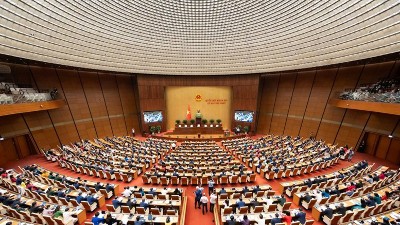
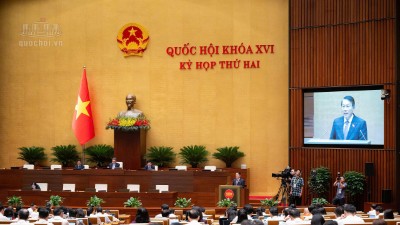
On October 26, at its ongoing second session, the 16th National Assembly heard proposal and verification reports on the draft Law on Protection of Important Works Related to National Security.
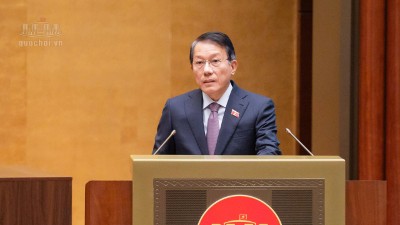
Presenting the summary proposal, General Luong Tam Quang, Member of the Politburo and Minister of Public Security, emphasized the necessity of enacting the law to promptly institutionalize the Party's guidelines on protecting important works related to national security. He stressed that the law ensures constitutional compliance, systemic legal consistency, and compatibility with international treaties to which Vietnam is a signatory.
The draft law also aims to resolve existing operational limitations, simplify administrative procedures, and enhance national security, social order, and socio-economic development.
The draft law submitted to the National Assembly comprises 41 articles across seven chapters.
Regarding classification, the draft law categorizes important works related to national security into three main groups:
- Group 1: Key national security works located in vital areas as defined by guard laws;
- Group 2: Security works and zones managed and utilized by the People's Public Security forces to safeguard national security and social order, further divided into three types based on their functions and objectives; and
- Group 3: Other important works related to national security are those under the state management functions and tasks of agencies, organizations, and localities, excluding works managed by the Ministry of Public Security and the Ministry of National Defense.
Based on the importance and protection requirements, other important works related to national security are classified into three types. Additionally, the authority to decide on including works in the list of national security-related works is assigned to the Prime Minister (for Type I works), the Minister of Public Security (for Type II works), and the Chairman of the provincial People's Committee (for Type III works).
Senior Lieutenant General Le Tan Toi, Chairman of the National Assembly's Committee on National Defense, Security, and Foreign Affairs, stated that the committee fully agreed on the necessity of enacting the law.
Regarding the scope of regulations, the committee suggested clarifying boundaries with specialized laws, particularly for dual-use works and non-physical infrastructure (digital infrastructure, data centers).
On identification and classification criteria, the committee recommended studying a unified system of criteria and classification methods; adding quantitative criteria for Type 1 works (energy security, digital infrastructure); and specifying principles and criteria groups - such as dependency level, replaceability, and operational continuity - directly in the law, while tasking the Government with defining specific technical thresholds.
Regarding change of use purpose for security works and zones, the committee basically agreed with the draft’s principles, cases, and authority.
However, it noted that allocating new land funds must align with security land-use planning and provincial planning under Clause 4, Article 68 of the 2024 Land Law, ensuring consistent order of priority for applying compensation and support laws with the Land Law.
Addressing the protection regime for restricted areas, security works, and zones, the committee highlighted that article 20 of the draft law imposes several contents restricting rights to freedom of movement, residence, and audio or video recording, while assigning details to the Government and the Minister of Public Security.
The committee urged defining the criteria and conditions for applying these restrictive measures directly within the law, while adding principles for technical surveillance - such as purpose-specific data collection and retention periods - to safeguard personal data.
Finally, on protection forces and regimes, the committee called for clear boundary delineation. Public Security forces should serve as the core force protecting Type 1 works and security works, while forces of agencies and enterprises should directly protect Type 2 and Type 3 works; stipulating regimes and policies according to specialized legal guidance; and stipulating special incentives (hazardous and dangerous allowances) for protection forces stationed in border, island, and remote areas.


 Google translate