


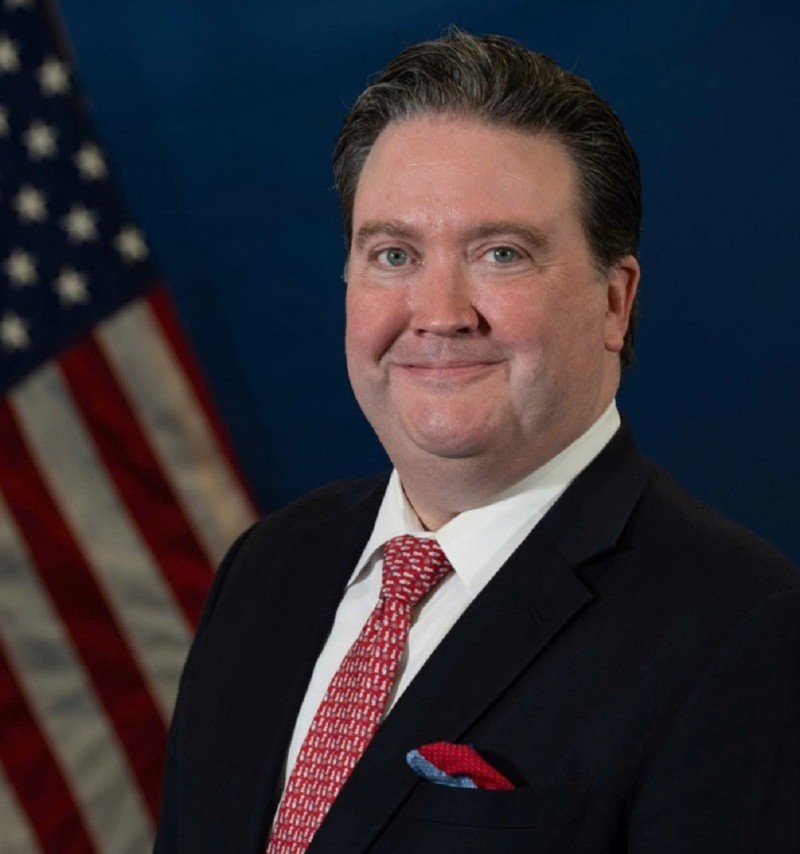
As VnEconomy (both Vietnamese and English editions) this morning quoted Vietnam’s Ministry of Industry and Trade as reporting that on the evening of November 25 (Hanoi time), the Office of the United States Trade Representative (USTR) issued preliminary findings in its Section 301 investigation under the Trade Act of 1974 into structural excess capacity and production in manufacturing industries across 14 of the 16 economies under investigation, including Vietnam. H.E. Mr. Marc Knapper, Former U.S. Ambassador to Vietnam, tells Vietnam Economic Times / VnEconomy about the impact of the new US tariff policy on Vietnam’s export competitiveness and trade relations with the US.
1. Impact of the new US tariff policy
- If the US decides to maintain a 20% tariff on Vietnamese goods, compared with 15% for the EU, Japan and South Korea, and 20% plus the existing 25% tariff on China, how do you think this will affect Vietnam’s export competitiveness and trade relations with the US?
First, a caveat: I’m speaking as a private citizen. I’m not privy to the details of the ongoing Agreement on Reciprocal Trade negotiations, and what was announced is a proposal, not a final decision. It’s understandable that many in Vietnam are disappointed. Vietnam is a Comprehensive Strategic Partner of the United States and has engaged constructively on Washington’s concerns, including increasing purchases of American goods, tackling illegal transshipment, and improving market access. A proposed rate higher than those of Japan, Korea, and most of its neighbors doesn’t seem to reflect that effort.
There are still real issues on the table. Intellectual property enforcement and making sure American and other foreign companies compete on a level playing field are long-standing concerns. These are exactly the issues a good agreement can resolve.
On competitiveness, the comparison with the EU, Japan, and Korea matters less than it looks. Vietnam mostly competes with its neighbors and with China. Against China, Vietnam’s position remains strong, because Chinese goods would face 20% on top of the duties imposed since 2018. Against several neighbors, the proposed gap is relatively small, though how these rates interact with existing duties still needs to be clarified. For price-sensitive sectors like apparel and footwear, even a small gap can shift some orders at the margin. But it’s unlikely to reverse most investment decisions, which depend on far more than tariffs.
The bigger risk is the 35% fallback, and the uncertainty itself. Businesses can plan around a known rate. Uncertainty is harder. The best outcome for both countries is an agreement that gives businesses clarity and reflects the partnership the two countries have built.
2. Chinese investment and rules of origin
- How will the US distinguish legitimate Chinese investment and manufacturing activities in Vietnam from operations designed to circumvent US tariffs? What should Vietnamese companies do to demonstrate genuine local production and comply with rules of origin?
Part of the problem is that “transshipment” is badly misunderstood, and the misunderstanding has real costs for Vietnam. In the US debate, the term gets used for two very different things. One is outright fraud: Chinese goods relabeled “Made in Vietnam” and shipped onward with little or no processing. The other is perfectly legal manufacturing in Vietnam that uses Chinese components, which describes almost every electronics and consumer-goods supply chain in the world, including American companies’. Lumping them together unfairly puts Vietnam’s honest manufacturers, and Vietnamese workers, under a cloud of suspicion they don’t deserve.
The US already has the tools to tell them apart, from the “substantial transformation” test to origin verifications and customs investigations. The question isn’t whether a factory is Chinese-owned. It’s whether real manufacturing happens in Vietnam. A Chinese-invested plant that employs thousands of Vietnamese workers, buys local inputs, and makes a genuinely new product is legitimate investment. A warehouse that relabels finished goods is not, and Vietnam wants that fraud stopped as much as anyone, because it threatens honest exporters.
Serious Vietnamese exporters are already doing what’s needed: investing in traceability, vetting suppliers, increasing local sourcing, and meeting the demanding compliance standards of their American buyers. These companies are Vietnam’s best argument. Every clean, well-documented supply chain makes the case for Vietnam as a whole that much stronger.
3. Vietnam’s position in global supply chains
- What should Vietnam prioritize to strengthen its domestic manufacturing capacity, increase local content and added value, and maintain its position as an attractive destination for global supply chain investment?
Vietnam is already pursuing this agenda, from streamlining administrative procedures to developing the semiconductor workforce. The question is how to sustain the pace of implementation. As I see it, a few areas matter most.
First, reliable electricity. For advanced manufacturers, especially semiconductors and data centers, a stable power supply is non-negotiable. The 2023 power shortages in the north left a lasting impression on investors. Vietnam’s moves to expand generation and transmission and to allow direct power purchase agreements are important, and continued progress here may be the single strongest signal it can send.
Second, investment-ready industrial land. Vietnam’s established electronics hubs in Bac Ninh and Hai Phong already host many of the world’s leading manufacturers, and newer projects like Tan Phu Trung in Ho Chi Minh City can bring that kind of large, integrated manufacturing hub to the southern economic region. Expanding this kind of high-quality capacity, with the surrounding infrastructure keeping pace, will help Vietnam win the next wave of investment.
Third, trusted digital infrastructure. High-tech investors increasingly look at network security before committing. Using trusted suppliers for IT, telecommunications, and data infrastructure, and building more resilient undersea cable connections with trusted partners, will weigh heavily with American, Japanese, Korean, and European companies deciding where to place sensitive operations. The repeated cable disruptions of recent years make this both a security issue and a business issue.
Fourth, supplier depth and skills. Growing a base of Vietnamese suppliers that can feed the large FDI manufacturers, and training the engineers and technicians that semiconductors and electronics require, are where the long-term gains in local value-added will come from. These are areas where partners like the United States can help.
Fifth, predictability and fair treatment. Vietnam’s institutional reforms are moving in the right direction, but work remains. Stronger intellectual property enforcement matters to every high-tech investor. So does ensuring that American and other foreign companies compete on equal terms with domestic firms, in licensing, procurement, and regulation.
Vietnam’s advantage was never just low tariffs. If it keeps delivering in these areas, it will remain one of the most attractive destinations for supply chain investment, whatever the tariff rate.
4. Washington’s perspective versus Vietnam’s reality
- You previously noted that only a very small proportion of Vietnam’s exports to the US involved illegal transshipment. However, the latest US tariff measures and trade investigations suggest that concerns over this issue remain significant in Washington. Do you see a gap between US policymakers’ perceptions and the realities of manufacturing and exports in Vietnam? How can Vietnam bridge that gap and maintain US confidence?
Yes, there’s a real gap, and I understand the frustration many Vietnamese feel about it. As I mentioned, part of the problem is that “transshipment” has become an elastic term in Washington. Treating legitimate manufacturing as if it were fraud penalizes exactly the kind of supply chain diversification the United States has long encouraged.
In my experience, the illegal kind of transshipment is a very small share of Vietnam’s exports. Perceptions in Washington are driven more by the headline trade surplus than by factory-level reality. Much of that surplus comes from American, Korean, Japanese, and Taiwanese companies producing in Vietnam for American consumers. American companies and American demand helped create the surplus that Vietnam is now being blamed for.
Vietnam has done a lot on this. It has tightened its certificate-of-origin system, stepped up inspections, taken action against violators, cooperated with US customs, and committed to buying more American goods, from aircraft to agricultural products to energy. Vietnamese officials and business leaders have made that case consistently.
That doesn’t mean everything is settled. Intellectual property protection remains a real concern for American companies, and fair treatment of foreign businesses is an ongoing task. These issues are legitimate, and progress on them serves Vietnam’s own goal of attracting high-tech investment. But they’re separate from transshipment, and they shouldn’t be used to cast doubt on the integrity of Vietnam’s exports.
The gap persists less because of anything Vietnam has failed to do than because perceptions in Washington are slow to change, especially when trade is so politically charged. The answer is persistence: continuing the enforcement and cooperation already underway, showing concrete progress on IP and market access, and making sure the American companies, investors, and consumers who benefit from this relationship also speak up. Their voices carry particular weight in Washington.
Trust has to run both ways. It’s worth protecting, with continued transparency from Vietnam and fairness from Washington.




 Google translate