



The world’s first monetary system began with a cashless arrangement in the form of the barter system, where goods and services were exchanged directly without any go-between. As modern history unfolded, however, the rise of the monetary intermediary created a system dependent on an instrument of exchange, with silver established as the world’s first global currency and cash, banknotes, and checks finding favor after the Industrial Revolution.
A massive turning point is now occurring in the 21st century, with a shift from a cash-based system to a cashless system. A cashless society is one in which cash, in the form of physical banknotes, is not accepted. Rather, people transfer money to one another digitally.
Ideal system
According to UN Trade and Development (UNCTAD), business e commerce sales have grown rapidly since 2016, based on figures available across 46 developed and developing economies that generate three-quarters of global GDP. E-commerce sales in 2018 were up 8 per cent from 2017, standing at $25.6 trillion globally and then nearly $28 trillion in 2024. UNCTAD also estimates that 1.45 billion people, or one-quarter of the world’s population aged 15 or older, made purchases online in 2018.
Fortune Business Insights, updated in October 2026, showed that the global cashless payments market size was $139.61 billion in 2024, which was projected to grow to $152.15 billion in 2025 and $295.08 billion by 2032, for a compound annual growth rate (CAGR) of 9.92 per cent during the period. The cashless payments market is experiencing rapid global expansion, driven by increasing demand for digital payment solutions, shifting consumer preferences, mobile adoption, and fintech innovation.
Key players in the market include Visa, Mastercard, Apple Pay, Google Pay, Samsung Pay, and PayPal, which focus on enhancing user convenience and security while expanding contactless and mobile phone wallet adoption and integrating value-added services, including “Buy Now, Pay Later” (BNPL).
By geography, the market is categorized into North America, Europe, Asia-Pacific, South America, and the Middle East & Africa. North America accounted for the largest share of the global market. Meanwhile, the Asia-Pacific is expected to expand at the fastest CAGR to 2032, with growth propelled by rapid digital transformation, high smartphone and internet penetration, and the explosive rise of mobile wallets and QR code-based payments.
The booming e-commerce sector in Asia-Pacific and increasing consumer preference for secure cashless payment methods further accelerate its adoption. Moreover, financial inclusion efforts and digital banking innovations are also expanding access, making Asia-Pacific the world’s fastest-growing and most dynamic market.
Among Asia-Pacific markets, Vietnam is a potentially promising one due to its wide coverage area, low internet service fees, and rapid increase in the percentage of people using smart devices.
It also has a growing digital economy, driven by its rapidly-expanding e-commerce sector, and one of the highest internet penetration rates worldwide. This digital transformation has ignited progress across various sectors, with digital payments experiencing impressive growth. Once among the most cash-dependent nations in Asia, Vietnam is embracing cashless transactions at an unprecedented pace.
Evolving transactions in Vietnam
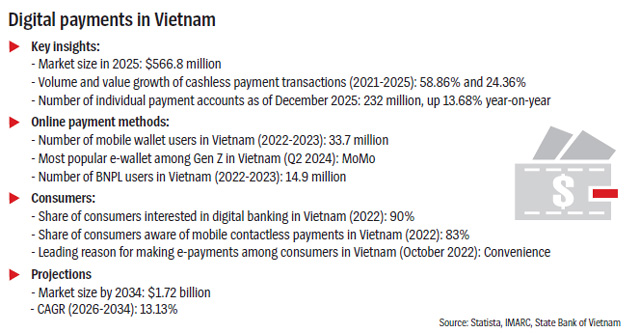
Vietnam has one of the highest cashless payment adoption rates in Southeast Asia, with the number of users expected to continue growing, fueled by the rise of many Vietnamese payment apps. While Vietnamese primarily use apps like MoMo, ZaloPay, and VNPay, popular international options such as Apple Pay and Google Pay are also available. Additionally, Vietnam’s national QR code payment (VietQR) is now widely used by local people for everything from coffee to retail. It allows payments to go directly from one bank or e-wallet account to another, making transactions fast and convenient.
On May 25, 2026, the Prime Minister signed Decision No. 928/QD-TTg approving the National Financial Inclusion Strategy for the 2026-2030 period, setting a number of important targets, including ensuring that, by 2030, 95 per cent of people aged 15 and above will have bank transaction accounts while the value of cashless payments will stand at 30-times GDP.
During a June seminar entitled “Smart Payments Drive Digital Finance”, Deputy Prime Minister Nguyen Van Thang emphasized cashless payments not only as a convenient tool but also as a key driver of digital finance development. Vietnam, he said, has witnessed a revolution in consumer behavior and cash flow management across society. Cashless payments have now become an essential requirement in the economy and society, supporting the development of a comprehensive, modern, and secure financial ecosystem centered on serving citizens and businesses. Within this ecosystem, cashless payments have become the lifeblood of the digital economy, connecting banks with sectors such as commerce, healthcare, education, transportation, tourism, public services, and other digital platforms.
According to figures from the State Bank of Vietnam, as of the end of 2025, 88.96 per cent of citizens aged 15 and above had bank accounts. Cashless transaction volumes rose more than 42 per cent and value nearly 23 per cent. The value of cashless transactions last year reached 28-times GDP. “Therefore, the likelihood of achieving the targets set by the National Financial Inclusion Strategy for 2026-2030 is highly promising”, the Deputy Prime Minister was quoted as saying. “Digital payments are a crucial condition for accelerating money circulation, expanding access to financial services, improving management efficiency, and creating momentum for digital economic growth in the new era.”
Vietnam is rapidly expanding cross-border QR payment connectivity with regional partners to facilitate seamless international transactions. The National Payment Corporation of Vietnam (NAPAS) has established bilateral payment links with Thailand and Laos, and has plans to extend connectivity to China, Japan, and South Korea. In December 2025, it officially launched the Vietnam - China cross-border QR payment service in collaboration with UnionPay International, enabling Chinese tourists to pay directly at Vietnamese merchants using VietQR Global codes. This initiative promotes local currency use, supports tourism growth, and strengthens regional financial integration.
Remaining gap
Despite their potential development, cashless payments in Vietnam still face significant challenges, including disparities in access to such services between urban and rural areas, while some groups, for example the elderly and low-income earners, remain hesitant or have yet to gain access to modern payment methods. Expanding payment infrastructure, enhancing interoperability, ensuring cybersecurity, and protecting personal data have become increasingly urgent requirements amid complex high-tech crime.
For cashless payments to reach 30-times GDP by 2030, the Vietnamese Government has instructed ministries, agencies, and local authorities to accelerate the completion of regulatory frameworks, policies, and technical standards that promote the application of digital technology in banking activities and to strengthen connectivity between credit institutions, fintech companies, and financial service providers. Ultimately, inclusion will decide whether Vietnam’s cashless story is only an urban success or a national achievement.






 Google translate