



Throughout the digital transformation process conducted over the past many years, data and business secrets have remained vital assets of every organization. Data determines competitive advantage, the customer experience, and even the survival of an enterprise or a bank. However, our digital asset governance environment is facing unprecedented pressure arising from three major turning points.
First, an increasingly stringent regulatory landscape. The year 2026 marks an important milestone as Vietnam officially applies the Law on Personal Data Protection and the Law on Cybersecurity in a synchronized manner. On July 6, 2026, Deputy Prime Minister Phan Van Giang signed Decision No. 125/QD-TTg approving the Scheme on “Development of the Quantum-Resistant Cryptographic System for the 2026-2035 Period,” marking a strategic implementation step to enhance information security capabilities, safeguard national digital sovereignty, and meet the demands of digital economic development amid rapid global advancements in quantum technology.
For enterprises, data protection is no longer just a technical support task of the IT department but has become a mandatory legal responsibility and a top strategic priority on the desks of Boards of Directors, executive management, Chief Information Officers (CIOs), and Chief Information Security Officers (CISOs). A data disruption or leakage incident causes not only financial losses but also directly impacts a business’s brand reputation and legal compliance.
Second, the explosion of AI in the hands of attackers. AI is fundamentally changing the cybersecurity game. Whereas attacks previously required considerable time and effort, AI now enables adversaries to automate vulnerability scanning, drastically shortening the time from flaw detection to system compromise. Attack speeds are measured in seconds, while human response speed remains limited. A prime example is the historical hack targeting Binance on October 29, with stolen funds reaching up to $6.3 billion, recorded as the largest cyberattack in the history of the global cryptocurrency industry.
Just over a week earlier, PHP disclosed two vulnerabilities collectively known as PHP2Shell. These two flaws are exceptionally dangerous because PHP is the technology underlying up to 70 per cent of websites worldwide. Discovered with the assistance of AI after remaining undetected in source code for years, these vulnerabilities could allow hackers to execute unauthorized code on unpatched PHP servers, thereby taking control of systems and stealing data. Experts fear that AI could help hackers analyze patches, quickly develop exploit tools, and attack servers before administrators have time to update them.
Third, an existential challenge for the entire current security infrastructure: the risk from quantum technology. The greatest risk of quantum computers lies not in a distant future five or ten years away but in the very scenario experts call “Harvest Now, Decrypt Later.” Attackers can quietly gather and copy your sensitive datasets, banking transactions, technological secrets, or customer information today, then store them and simply wait until quantum computers become powerful enough to decrypt all that data.
Facing this picture, the concept of “Post-Quantum Security” has emerged as a mandatory shield to protect enterprise digital assets over a 10 to 30-year horizon.
However, from an economic executive and corporate governance perspective, we deeply empathize with the concerns of leadership teams. The biggest question raised by Boards of Directors and Chief Financial Officers (CFOs) today is not how advanced the technology is but rather: “How can we protect systems against new threats without disrupting existing operations? How can we upgrade security without replacing the entire expensive hardware infrastructure? And how should the investment roadmap be structured so that costs always remain under control?”
We cannot throw away millions of devices or demolish and rebuild existing Core Banking systems or network infrastructures. Enterprises need a flexible, software-defined adaptation solution that upgrades security, much like installing a new software layer on top of an existing platform, helping optimize every single investment dollar.
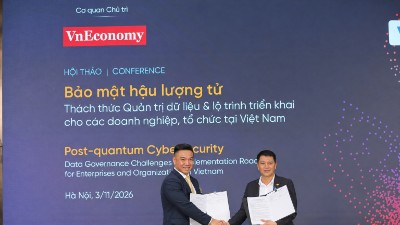
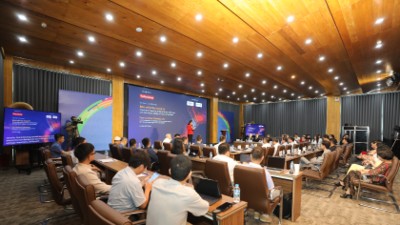
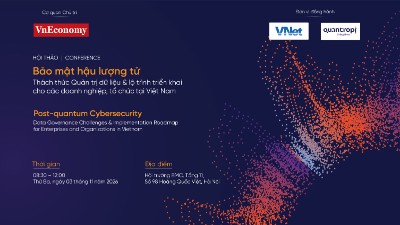
That is why Vietnam Economic Times / VnEconomy, in collaboration with Quantropi - a pioneering post-quantum security technology company from Canada - and partner VNET Vietnam, decided to initiate an Executive Roundtable Workshop entitled “Post-Quantum Security: Data Governance Challenges & Implementation Roadmap for Enterprises and Organizations in Vietnam,” held on November 3.
With the core action motto “Assess first, test limits, measure effectiveness, then deploy,” the Roundtable was designed not merely to showcase technology or introduce products. We aim to create an open and candid dialogue space reserved specifically for senior executives.
(*) Mr. Dao Quang Binh is General Secretary of the Vietnam Economic Association, Vice President of the Editorial Board, and General Managing Editor of Tap chi Kinh te Viet Nam /Vietnam Economic Times / VnEconomy.
Asia-Pacific Facing Transition to the Post-Quantum Cryptography (PQC) Era

Cryptanalytically-relevant quantum computers could break many public-key cryptographic systems in use today, with some industry forecasts suggesting this could happen as early as 2029, according to SDxCentral.
Specifically, risks emerge even before those computers officially arrive: attackers can already collect encrypted data today and decrypt it later, a method known as “Harvest Now, Decrypt Later.” A related risk is “Trust Now, Forge Later,” which could undermine future trust in digital signatures issued today to authenticate software, hardware firmware, certificates, business agreements, and transaction records. Post-Quantum Cryptography (PQC) addresses these risks with algorithms designed to withstand attacks from future quantum computers. Despite its name, PQC can still be deployed on current infrastructure today.
The CCAPAC 2026 Annual Report: Quantum Readiness in Asia - Risks and Opportunities, conducted with support from Cisco and AP Institute, highlights that the progress of this technology across the Asia-Pacific region is ongoing but uneven.
Singapore and Japan demonstrate advanced readiness, combining strong research foundations, operational quantum-secure deployments, and proactive regulatory engagement. “South Korea is advancing rapidly through government mandates and industrial capability,” the report noted. “Australia has strategic orientation and could work to translate policy into mandatory compliance requirements. India faces a scale challenge, with 1.4 billion people and emerging quantum infrastructure. China is pursuing a dual QKD+PQC strategy with extensive infrastructure deployment but no mandatory PQC deadline.”
The report also noted that cryptographic inventories are incomplete or nonexistent in most organizations, with HNDL and TNFL threats underappreciated at the strategic and operational levels. “Regulatory mandates alone may not be sufficient to drive the necessary migration pace in the region,” it added. “Small and medium enterprises (SMEs), which are critical to regional supply chains, lack awareness and resources. The skilled workforce required to execute PQC migrations correctly is scarce.”
It also highlighted that the transition to PQC encounters major hurdles due to four technical risks: Internet of Things (IoT) devices / embedded hardware that cannot be software-patched and must be physically replaced; increased complexity and costs from implementing hybrid solutions for legacy systems; performance burdens on bandwidth and memory caused by larger PQC key sizes; and the risk of global incompatibility as countries such as India, South Korea, and China develop their own domestic standards.
According to SDxCentral, Asia-Pacific is still considered a region with all the prerequisites to break through, including leading digital economies, advanced technology infrastructure, robust cybersecurity frameworks, and accelerating quantum research capabilities.
Nevertheless, readiness will not happen naturally without proactive action. The action agenda is clearly outlined: raise awareness of quantum risks, bring transparency to control capabilities, set clear timelines, standardize technical specifications, optimize procurement policies, prioritize the protection of core infrastructure, empower SMEs, and place strong emphasis on workforce training.





 Google translate