


Born in the “Roaring 20s” with the launch of the Sherry-Netherland Hotel on Fifth Avenue in New York City, branded residences are properties where the developer partners with a well-known brand to create a guarantee of quality and the promise of an exceptional living experience. A surge in popularity since the turn of the millennium has pushed branded residences to the forefront of the real estate market for high-net-worth individuals (HNWIs). The concept continues to gain traction around Asia.
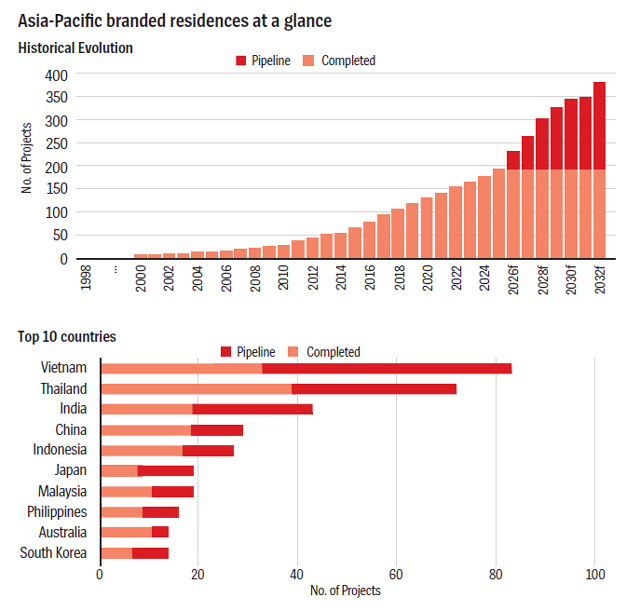
According to the Branded Residences 2026 Report from Savills, released in September, the Asia-Pacific is currently the second-most established branded residential region globally, accounting for approximately 23 per cent of all completed schemes worldwide. While the region continues to demonstrate impressive momentum, with a further 187 projects expected to be delivered by 2032, the nature of its growth story is evolving.
As Vietnam’s property sector proved increasingly favorable among international investors due to its stellar economic growth, global hoteliers have accelerated their push into the country’s branded residence segment. Savills reported that Vietnam currently leads the Top 10 countries in the region in the number of branded residence projects, with supply forecast to increase by 152 per cent by 2032.
New entrants
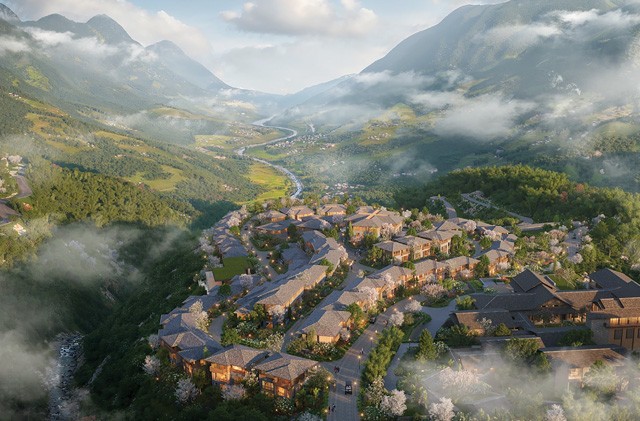
In early September, IHG Hotels & Resorts and the Alphanam Group announced their collaboration on The Residences at InterContinental Sapa Resort, marking the debut of InterContinental branded residences in Vietnam’s northwest region. Located in the spectacular Muong Hoa Valley in Sapa, Lao Cai province, the development represents a significant milestone for IHG’s luxury residential portfolio in one of Vietnam’s most culturally-rich and naturally-distinctive destinations.
The residences will form part of the 83-ha Alphora Muong Hoa International Resort Complex, developed by the Alphanam Group. The Residences at InterContinental Sapa Resort will comprise 79 branded villas, offering homeowners access to range of hotel facilities and services, including dining, wellness, concierge, and hospitality experiences.
“This landmark development brings together the global strength and legacy of the InterContinental brand with the distinctive character and natural beauty of Muong Hoa Valley, creating an exceptional branded residential offering in one of Vietnam’s most remarkable destinations,” said Mr. Bryan Chan, Vice President, Development, Southeast Asia & Korea, at IHG Hotels & Resorts. “As Vietnam continues to growth its position as one of the world’s leading branded residences markets, this project reflects the increasing demand for high-quality branded living experiences and our long-term confidence in the country’s hospitality and residential sectors.”
The launch further expands IHG’s luxury and lifestyle presence in Vietnam and reinforces the company’s strategy of growing its branded residences portfolio in high-potential destinations across the region. IHG currently has 35 branded residential projects open or in the sales phases with the owner or developer, across 19 countries, with additional opportunities in the pipeline. Signings in 2026 to date for future branded residences developments included The Regent Ho Tram in Vietnam.
Previously, in February, Marriott International announced a milestone agreement with Masterise Group to develop a branded residential project in Vietnam. The launch of The Ritz-Carlton, Saigon and The Ritz-Carlton Residences, Saigon is poised to set a new benchmark for luxury hospitality in Vietnam.
“Our collaboration with Masterise Group is founded on a shared vision and a long-term commitment to excellence,” said Mr. Gautam Bhandari, Chief Development Officer, Asia Pacific excluding China at Marriott International. “Together, we are developing projects that we expect to stand as enduring icons and operated in full alignment with the rigorous quality standards of Marriott International’s world-leading brands.”
Last year, JW Marriott Residences, Grand Marina Saigon, Sea, opened its doors in Ho Chi Minh City’s District 1, marking the debut of the brand’s first urban branded residence in the Asia-Pacific. Standing 47 floors high, Sea Tower is positioned to provide uninterrupted panoramic views of the Saigon River, setting a new standard for branded luxury living in Vietnam.
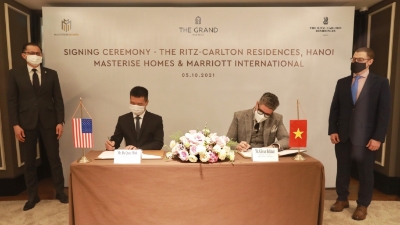
Marriott International also signed another agreement with Masterise Group to bring Hanoi at The Grand, the Ritz-Carlton Residences to life with the promise of delivering to Vietnam the ideal structure of branded residences with benchmarked Ritz-Carlton’s global standards and luxury offerings in the market.
Next growth hotspot
Across the Asia-Pacific, according to the Savills report, the share of standalone branded residence projects is forecast to decline from 30 per cent of completed supply to 16 per cent of the future pipeline, as the integrated residential-hotel model becomes increasingly common. Meanwhile, in Ho Chi Minh City and Bangkok, Thailand, the number of standalone projects in the pipeline expected to be developed through 2032 is projected to double.
This trend shows that the potential for branded residences in Vietnam is expanding across multiple models, from destination resort products to branded residences in major cities.
According to Savills Hotels research, an increasing number of branded residence developments are being launched in partnership with international hospitality operators, including Marriott International, IHG, and Hyatt. These projects account for 60 per cent of the future development pipeline, compared with just 28 per cent of existing branded residence supply.
This shift highlights the growing influence of global operators within the sector and reflects changing development patterns, with new projects increasingly concentrated in major urban markets such as Ho Chi Minh City, Hanoi, and Da Nang rather than traditional resort destinations.
Alongside established hospitality developers, several local residential developers are also considering branded residences as a new approach to the premium segment. According to Mr. Mauro Gasparotti, Senior Director, Southeast Asia, at Savills Hotels, and Founder of WeHub, the global ultra-luxury residential sector is being reshaped by a larger and increasingly mobile wealth base, with the global ultra-high-net-worth individual (UHNWI) population projected to increase by 29 per cent between 2021 and 2026. At the same time, branded residences have evolved from a niche segment into a mainstream luxury product, with more than 220 new projects currently under development worldwide.
Across many of the Asia-Pacific’s major economies, rapid wealth creation is generating a larger pool of HNWIs and UHNWIs who are seeking branded residences closer to home. With global billionaire wealth having grown by 121 per cent over the past decade, demand is becoming broader and more structurally embedded within intra-Asian markets, reducing the reliance on international purchasers.
Vietnam is also on a strong UHNWI growth trajectory, reflecting the country’s expanding wealth base and rising appeal as a destination for luxury residential, branded residences, and wellness-led real estate. “The market is expected to add 40 branded residence projects to its planning and development pipeline, underscoring the sector’s growing momentum and long-term potential,” Mr. Gasparotti said.
Compared to Thailand, Vietnam’s branded residence market remains at a relatively early stage of development, but several structural factors are supporting its long-term potential. Industry experts highlight several drivers behind this outlook, including the expansion of the country’s affluent and UHNWI population, the continued recovery of international tourism, and ongoing investment in transport infrastructure.
Looking ahead, the market is expected to see a growing number of developments launched in partnership with international brands, particularly across major urban centers and established resort destinations. At the same time, pricing within the segment is increasingly reflecting the value of brand affiliation, professional management, and service standards. While branded residences in Vietnam continue to command a premium, the market is still developing its pricing benchmarks compared with more mature destinations across the region.






 Google translate