



Vietnam entered 2026 with strong macro-economic momentum, underpinned by resilient exports, robust FDI inflows, large-scale infrastructure investment, and a series of structural reforms enacted in 2025. Policy initiatives aimed at enhancing private sector development, improving regulatory predictability, and raising financial transparency standards are expected to materially improve deal executability and investor confidence. Capital market upgrades, renewed IPO momentum, and the FTSE Emerging Market upgrade to the stock market further strengthen exit pathways and valuation support for merger and acquisition (M&A) participants.
Substantial momentum
In September, the VinFast Vietnam Joint Stock Company, a subsidiary of VinFast Auto Ltd., signed agreements to acquire 100 per cent of the equity interest in the Ngoc Hoi Real Estate Investment Joint Stock Company. Ngoc Hoi currently holds a 20 per cent economic interest in the investor consortium developing the Hanoi International Sports Urban Area Project (Vinhomes Global Sportia Hanoi), with Vinhomes serving as the lead developer authorized to coordinate and implement the project.
VinFast’s participation in the project is expected to generate additional and sustainable revenue and cash flow for the company. The supplementary cash flow from participation in the real estate sector will provide further support for VinFast to continue pursuing its core strategy of developing electric vehicles and a green transportation ecosystem. In addition, directly participating in the project through an active business approach from its early stage will enable VinFast to engage throughout the entire development lifecycle, allowing it to contribute to and capture a substantial share of the value generated by the mega-urban development.
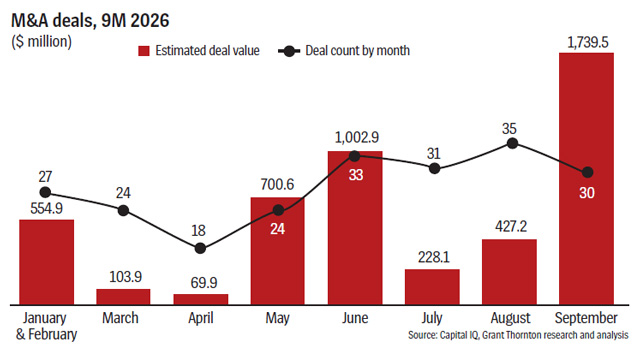
The VinFast acquisition, estimated at approximately $1.2 billion, was one of the most notable deals in September. According to Grant Thornton, Vietnam’s M&A market recorded 30 announced transactions in September. Among these, only 23 deals had disclosed or estimable transaction values, with an aggregate value of approximately $1.74 billion.
September M&A activity was driven by restructuring and related-party transactions, with four deals contributing approximately $1.23 billion and accounting for 70.7 per cent of total transaction value. In terms of transaction volume, logistics and infrastructure led with four deals, accounting for 14 per cent of transactions during the month. Real estate, consumer, industrials, and financials each recorded three deals, together accounting for 40 per cent of announced transactions.
Excluding restructuring and related-party transactions, consumer and metals and mining were the leading sectors in September, recording total deal values of approximately $183.8 million and $124.8 million, respectively, and together accounting for 61 per cent of total disclosed / estimable transaction value.
Notable transactions included the transfer of shares in the Thanh Thanh Cong - Bien Hoa Joint Stock Company, valued at nearly $179 million, and the Elmet Group’s acquisition of a 4.99 per cent stake in the Masan High-Tech Materials Corporation for approximately $138 million. The food and beverage (F&B) sector ranked third, with a transaction value of approximately $88.4 million, equivalent to 18 per cent of the market’s total deal value.
According to the National Statistics Office at the Ministry of Finance, as of the first nine months of 2026, Vietnam had attracted $50.36 billion in registered foreign investment, up 76.4 per cent year-on-year. Foreign investors completed capital contribution and share purchase transactions with an aggregate value of $6.97 billion, up 44 per cent year-on-year. Of these, 725 transactions involved capital contributions or share purchases that increased the charter capital of Vietnamese companies, with a total value of $2.64 billion. The remaining 1,610 transactions involved foreign investors acquiring existing domestic shares without increasing companies’ charter capital, with a total value of $4.33 billion.
Manufacturing remained the largest recipient of foreign investment, while real estate, energy infrastructure, information and communications, and professional and technology activities also attracted significant capital.
New cycle
According to industry experts, current market developments suggest that M&A activity is shifting away from transactions driven primarily by cost advantages and toward deals focused on building long-term competitive capabilities. Beyond capital investment, the next generation of M&A transactions is expected to facilitate technology transfer, management expertise, and stronger integration of Vietnamese businesses into global networks.
Dr. Oliver Massmann, Partner at Duane Morris, said Vietnam has entered a new phase of its development as an investment destination. For international investors, acquiring an existing Vietnamese business can provide something that a greenfield investment often cannot: immediate market access, an existing workforce and customer base, operating licenses, land and facilities, local distribution networks, established supply chains, and, critically, speed to market.
“Successful acquisitions in Vietnam require foreign investors to address not merely the share purchase agreement, but also foreign-investment market-access conditions, merger control, sector-specific approvals, land rights, foreign exchange rules, tax, licensing, beneficial ownership, employment, compliance and - in many transactions - the regulatory history of the target,” he said.
Vietnam’s GDP growth in 2026 is projected to remain robust, with manufacturing, exports, and public investment the key drivers, according to the latest projection by the World Bank released on October 6. It forecast Vietnam’s economic growth in 2026 to increase by 1.1 percentage points to 7.4 per cent; the largest upwards revision among Asia-Pacific economies. The 7.4 per cent projection also puts Vietnam at the top of the regional growth forecast. Against this backdrop, the Vietnamese Government has set a GDP growth target of above 10 per cent for 2026, a goal that many experts view as challenging yet achievable, supported by resilient domestic consumption and large-scale infrastructure investments.
According to Grant Thornton, supportive macro fundamentals and ongoing structural reforms continue to underpin a constructive outlook for the market in 2026 and over the longer term with improved transparency and deepening capital markets reinforcing deal momentum and investor confidence while external risks may temper near-term optimism. Overall, Vietnam’s M&A outlook for 2026 remains constructive, characterized by disciplined capital deployment, sector selectivity, and a continued shift toward high-quality, strategically-driven transactions.
The healthcare, energy, education, and industrials and logistics sectors are expected to remain the primary focus of M&A activity in 2026, supported by structural demand drivers, supply-chain realignment, and policy tailwinds. While external risks, including global demand volatility, geopolitical uncertainty, and shifting monetary conditions are likely to shape valuation discipline and deal structuring, these factors are not expected to derail the broader recovery.
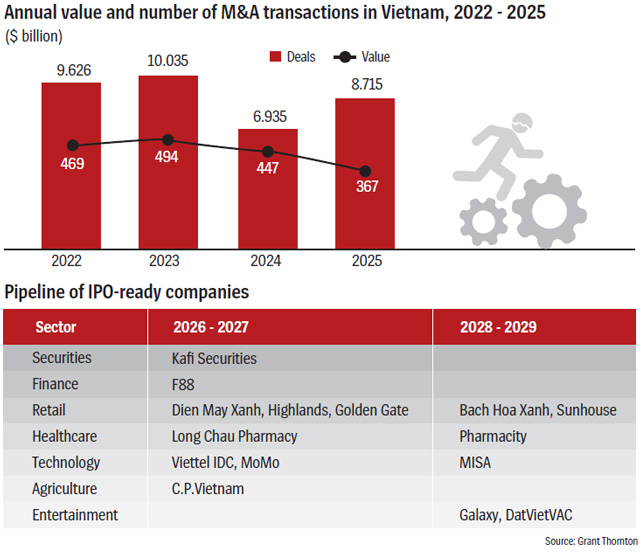
Additionally, IPO activity is expected to remain robust in 2026-2027, with planned issuance of approximately $50 billion, reinforcing private equity investment appetite and longer-term capital commitments.







 Google translate