



Founded on June 19, 1981, Vietsovpetro, the joint venture between Vietnam and Russia, is now the longest-running successful cooperative arrangement in petroleum exploration and production on Vietnam’s continental shelf. Over its 45 years of developing Vietnam’s oil and gas fields, Vietsovpetro has produced more than 250 million tons of oil. The joint venture currently consists of 16 subsidiaries, each of which constitutes a core function to support petroleum exploration and production activities. It is capable of executing complex petroleum projects - from seismic interpretation, exploration drilling, and field development to the engineering, fabrication, and installation of offshore facilities and the production and export of crude oil, not only for Vietsovpetro but also for other local and international companies.
Energy a vital pillar
On May 10, 2025, Vietnam and Russia signed three major oil and gas documents: the Protocol Amending the 2010 Vietsovpetro Agreement, proposing the extension of operations to 2050; the Protocol Amending the 2016 Rusvietpetro Agreement; and the Intergovernmental Agreement on Expanding Oil and Gas Cooperation.
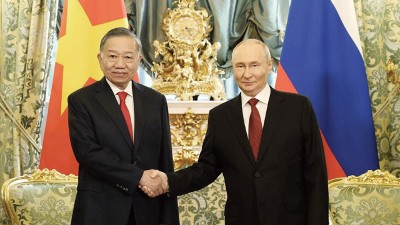
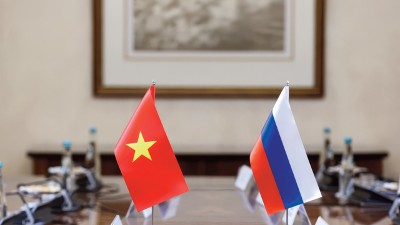
Recently, within the framework of the State visit to Russia by Party General Secretary and State President To Lam in September, the two sides issued a joint statement on further strengthening the Comprehensive Strategic Partnership (CSP) between Vietnam and Russia. Leaders of both sides reaffirmed that energy and oil and gas remain vital pillars of bilateral relations, while also agreeing to set science and technology and innovation as key growth engines.
Among the exchanged agreements within the State visit, numerous pacts directly pertain to Petrovietnam and its member units, covering areas from core oil and gas operations to strategic energy reserves and cutting-edge technologies. One was the Investment Registration Certificate presented to Petrovietnam and the Contractor Consortium comprising Zarubezhneft Asia, Vietsovpetro, and the PetroVietnam Exploration Production Corporation (PVEP), which solidifies the legal and operational framework for the partners to execute investment activities and maximize each party’s expertise and capacity in petroleum exploration, appraisal, and production (E&P).
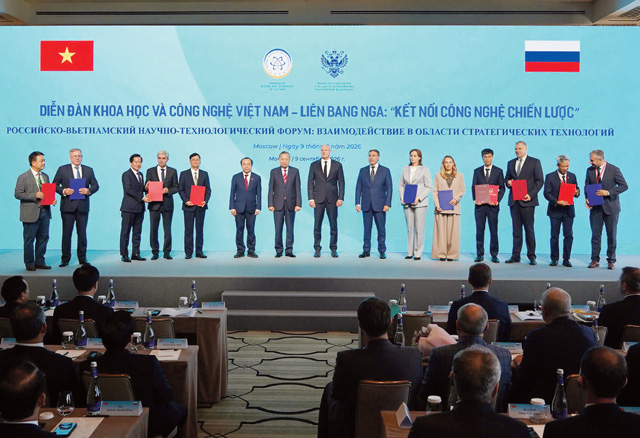
Another notable document was the Framework Agreement between Petrovietnam and Zarubezhneft on cooperation in studying investment options for the development of a strategic crude oil reserve in Vietnam. Amid recurring global energy market volatility and heightened risks of supply chain disruptions, building crude oil stockpiling capacity represents a pivotal strategic initiative to strengthen Vietnam’s national energy autonomy and economic resilience.
Additionally, the Investment Cooperation Agreement between PVEP and Zarubezhneft Asia unlocks further room for the two corporations to explore and execute new investment opportunities. This represents a tangible step in realizing the strategy to broaden operational areas, enhance the efficiency of existing ventures, and seek high-potential oil and gas projects in Vietnam, the Russian Federation, and third countries.
Mr. Sergei Kudryashov, General Director of Zarubezhneft, said it would explore expanding cooperation into renewable energy, offshore wind power, and projects in third countries. He also expressed interest in participating in new energy projects, studying the establishment of an energy hub, and developing supply chains and manufacturing facilities for energy equipment in Vietnam.
Advancing nuclear cooperation
Nuclear cooperation has also moved from discussion to concrete legal frameworks. In March, Vietnam and Russia signed an intergovernmental agreement on cooperation in the construction of the Ninh Thuan 1 Nuclear Power Plant. The plant represents a major milestone in Vietnam’s energy sector, opening up numerous opportunities for technological cooperation, knowledge transfer, and capacity building for Vietnamese enterprises, while contributing to national economic development.
The Ninh Thuan 1 project is part of Vietnam’s long-term strategy to diversify energy sources, reduce dependence on fossil fuels, and promote the development of clean, sustainable, and safe energy. The project comprises two units with an expected capacity of approximately 2,400 MW, employing modern technology and VVER-1200 safety equipment developed by Russia’s State-owned nuclear energy corporation, Rosatom.
Parallel progress is under way on the Center for Nuclear Science and Technology (CNST) in Dong Nai province. The proposed Center will feature a 10 MW research reactor, with the potential to be upgraded to 15 MW, alongside a scientific and industrial laboratory complex. The two sides are continuing discussions on technical requirements and the construction contract.
In late October, Rosatom and Vietnam’s Da Lat Nuclear Research Institute (DNRI) held talks in Dimitrovgrad during a visit to Russia by Mr. Nguyen Kien Cuong, Deputy Director of the DNRI. During the talks, the two sides focused on technical and organizational aspects of the CNST project, while reviewing additional requirements from the Vietnamese side concerning fuel utilization and silicon doping technology.
Mr. Alexander Tuzov, Director of the State Scientific Center - Research Institute of Atomic Reactors (SSC RIAR), said the project forms part of Vietnam’s long-term strategy to develop the peaceful applications of nuclear energy. He noted that, alongside the development of the new Center, Vietnam continues to operate the Da Lat Research Reactor, which uses Russian-supplied fuel and produces medical radioisotopes for domestic needs.
The new Center is expected to provide fresh impetus not only to nuclear science but also to related fields such as medicine, materials science, and biotechnology. Mr. Ilya Vergizaev, Director General of Rosatom Technologies of Construction, described the project as one of the most important cooperation initiatives in the history of Vietnam-Russia relations.
Continued discussions on technical requirements and the construction contract indicate that both sides are advancing the next stages of project preparation. Once operational, the CNST is expected to strengthen Vietnam’s nuclear research and technology application capabilities, while supporting the development of highly-qualified human resources to serve the country’s science and technology development objectives.
Elevated technology ties
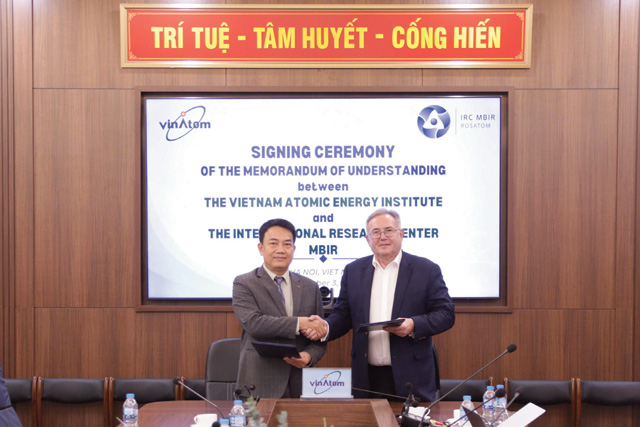
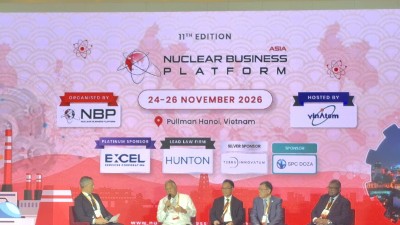
Science and technology cooperation between Vietnam and Russia has been elevated as a distinct pillar. On November 4, the Vietnam Atomic Energy Institute (Vinatom) and the Russian company leading the consortium behind the international research center based on the MBIR reactor, signed an MoU to promote scientific research and cooperation in nuclear technology. According to Rosatom, the agreement confirms both sides’ commitment to developing cooperation through the MBIR International Research Centre. This includes Vinatom’s participation in research activities conducted at the facility and discussions on the conditions for the Vietnamese institute to join the MBIR Consortium.
Dr. Tran Chi Thanh, President of Vinatom, described the new agreement as a strategic step towards strengthening cooperation in the peaceful use of nuclear energy. Both sides expect to pursue long-term joint research activities. Meanwhile, Mr. Vasily Konstantinov, General Director of the company leading the MBIR International Research Centre Consortium, for his part, said the MoU formalizes the two sides’ mutual willingness to cooperate and is expected to strengthen MBIR’s international scientific research agenda.
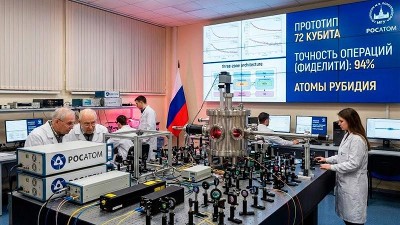
Previously, Petrovietnam and Rosatom had advanced work on an additive-technology center and transfer of 3D-printing materials production. A quantum-cooperation roadmap with Rosatom supports Vietnam’s longer-term strategy through 2045, including training, remote access to computing resources, and potential joint research facilities.
Last month, during a meeting with Mr. Valery Alexandrovich Fadeev, Advisor to the Russian President, Minister of Science and Technology Vu Hai Quan said Russia is one of Vietnam’s most reliable partners in the fields of science, technology, and education and training. To build upon traditional cooperative ties, Minister Quan continued, the two countries need to further expand links between research institutes, universities, and enterprises, converting cooperative orientations into practical, applicable research tasks. This cooperative foundation is being materialized through scientific and technological networking programs.
The Minister also noted that the recent Vietnam-Russia Technology Networking Forum in Moscow provided an opportunity to connect universities, research institutes, and technology enterprises of both countries. Attracting over 400 delegates, including about 300 from Russian research institutions, organizations, and enterprises, the Forum has opened up prospects for R&D and cooperation in technology transfer.
He also proposed that scientists from both countries soon connect and coordinate to formulate joint research tasks on high-performance battery production, aiming to exchange proposals at a bilateral scientific and technological cooperation session scheduled for late November. The two sides have also continued to promote cooperation in high-potential areas such as AI, digital technology, and atomic energy. He said that regarding the AI cooperation initiative proposed by the Russian side, the Ministry of Science and Technology (MoST) will report to competent authorities to consider subsequent implementation steps, moving toward the formation of specific cooperative projects.
Within the framework of his State visit to Russia in September, Party General Secretary and State President To Lam stressed that “Vietnam - Russia scientific and technological cooperation in the coming period requires new thinking, new approaches, and higher targets.” Accordingly, cooperation must extend beyond expert exchanges and personnel training to focus on jointly mastering technologies, co-creating products, and together entering markets.
To realize this objective, he proposed that both sides focus on five major orientations. First, elevating strategic technology cooperation into a vital new pillar of the Vietnam - Russia Comprehensive Strategic Partnership. Second, constructing large-scale scientific and technological programs and projects that serve as symbols of Vietnam - Russia cooperation in the new era. Third, placing enterprises at the center of science, technology, and innovation cooperation. Fourth, investing strongly in the young generation of Vietnamese and Russian scientists and experts. And fifth, establishing concrete and measurable organizational mechanisms.
The Party General Secretary and State President requested that MoST work closely with the Russian Ministry of Science and Higher Education and relevant agencies in both countries to quickly select projects viable for early deployment and draw up detailed implementation plans.
Future outlook
Though the future boasts potential, implementation remains the main challenge. Nuclear projects require sustained regulatory, financing, localization, and workforce preparation, while oil and gas expansion depends on geology, commercial terms, and operational efficiency. On the technological side, success will hinge on practical mechanisms for joint research, intellectual property arrangements, and scaling pilot projects into commercial activity.
For Vietnam, the cooperation supports energy security and progress toward higher-value industrial and technological capabilities. For Russia, it offers continued access to a growing Asian market, opportunities to deploy nuclear and energy technologies, and a platform for two-way investment.
The agreements in 2026 between the two countries and other high-level commitments have created a clearer roadmap. The years to come will test how effectively both sides convert those frameworks into operating projects, trained specialists, and measurable economic results.
Nuclear cooperation has also moved from discussion to concrete legal frameworks. In March, Vietnam and Russia signed an intergovernmental agreement on cooperation in the construction of the Ninh Thuan 1 Nuclear Power Plant. The plant represents a major milestone in Vietnam’s energy sector, opening up numerous opportunities for technological cooperation, knowledge transfer, and capacity building for Vietnamese enterprises, while contributing to national economic development.



 Google translate