


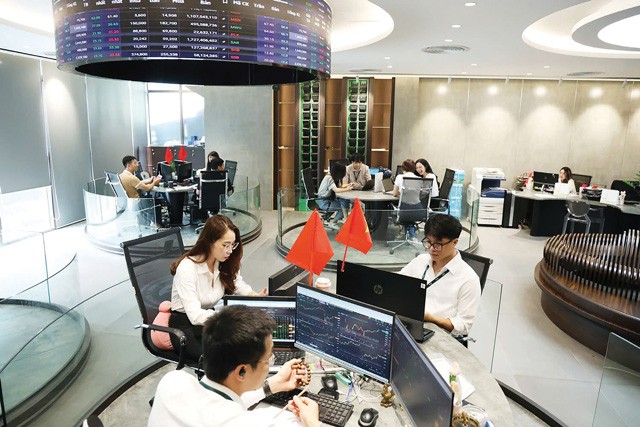
After years of reform, Vietnam’s stock market entered a new phase on September 21 when FTSE Russell officially upgraded it to “Secondary Emerging Market” status, opening the door to a broader pool of international investors. The transition will take place in four phases and run to September 2027, meaning that index-related capital flows will be allocated progressively rather than concentrated at a single point in time.
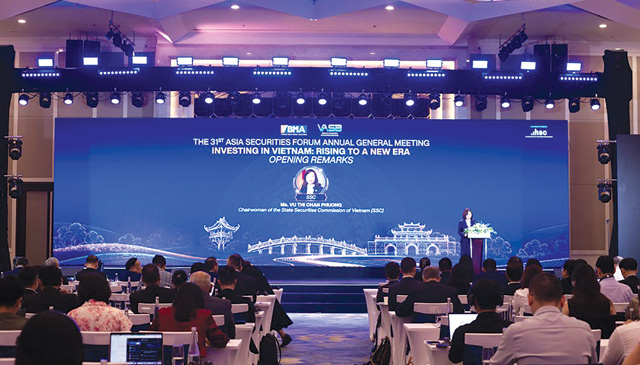
At the 31st Asia Securities Forum, with the theme “Investing in Vietnam: Rising to a New Era,” held in Hanoi on October 2, Ms. Vu Thi Chan Phuong, Chairwoman of the State Securities Commission of Vietnam (SSC), said that the capital market plays an increasingly important role, serving both as a channel for mobilizing medium and long-term capital for enterprises and as a bridge connecting domestic and international capital flows. “Being upgraded to emerging market status is not the final destination, but rather the starting point for a new phase of development,” she told the gathering.
“Ticket” to global capital
Data from the SSC noted that the market continues to expand, with numerous indicators showing significant progress. As of the end of September 2026, total stock market capitalization across the two exchanges stood at approximately $404 billion, equivalent to 81.7 per cent of GDP. The average daily trading value has remained around $1 billion since the beginning of the year. Meanwhile, the number of securities trading accounts has reached nearly 13.9 million, reflecting the market’s growing scale and potential.
Ms. Phuong also affirmed that FTSE Russell’s upgrade marks a historic milestone. “This achievement reflects years of effort dedicated to refining the legal framework, modernizing technical infrastructure, and enhancing market accessibility for international investors,” she said.
Under the SSC’s targets, by 2030, foreign investors’ assets are expected to reach approximately 15 per cent of GDP, while total net assets under fund management are targeted at around 5 per cent of GDP. Pension fund assets are expected to grow by an average of 11.5 per cent annually. If these targets are achieved, the market will gain not only additional foreign capital but also a larger pool of long-term funding that is less dependent on short-term fluctuations in capital flows.
From an international perspective, according to the World Bank (WB), FTSE Russell’s upgrade could unlock around $3-5 billion in portfolio inflows during the initial years and potentially as much as $25 billion by 2030 if reforms continue to be implemented. The WB has also emphasized that a deep and liquid capital market capable of mobilizing private capital on a large scale will be critical to Vietnam’s long-term development. The next challenge, therefore, is not simply to attract capital, but to create a market of sufficient quality to retain it.
In addition, Mr. Anup Gupta, Chairman of the Bombay Stock Exchange Brokers’ Forum (BBF) in India, said Vietnam is a dynamic economy with many good companies, including businesses operating in financial services. “Given the country’s growth rate, investors want to participate in its growth story and may therefore look to Vietnamese companies as investment opportunities,” he added. “However, for long-term capital flows, Vietnam also needs to broaden market access, maintain low initial participation requirements, strengthen investor education, and ensure an effective regulatory and supervisory framework. This is why the market upgrade can be viewed as an ‘entry ticket’ rather than the final destination.”
Challenges to address
Following the market upgrade, according to Mr. Nguyen Hoang Duong, Vice Chairman of the SSC, Vietnam’s stock market will now need time to gain access to and become familiar with a new investor base. Vietnam’s objective is not simply to attract capital, but to build a market that is “safe, efficient, reliable, and sustainable” for regional and global investors. This underscores the fact that, while the upgrade is an important milestone, it is only the beginning of a much broader process.
Inclusion in global indices will give Vietnamese equities greater visibility within the capital allocation universe of international funds. However, passive index-tracking capital and active institutional investment operate on fundamentally different principles. Passive capital primarily follows index composition and portfolio rebalancing. Active funds, by contrast, make investment decisions based on earnings prospects, valuations, corporate quality, risk levels, and the protection of shareholder interests. Therefore, the impact of the market upgrade should not be measured solely by the amount of capital that may enter Vietnam during the first few rounds of rebalancing.
Meanwhile, Ms. Tehmina Khan, World Bank Lead Country Economist for Vietnam, Cambodia and Laos, observed that Vietnam does not lack savings capital.
WB figures indicate that Vietnam’s savings rate stands at 37 per cent of GDP, whereas in many emerging market economies across Europe, Asia, and Latin America, this figure typically ranges from only 22 to 24 per cent. Meanwhile, Vietnam’s historical investment rate has hovered around 30 per cent of GDP. “Consequently, in recent years, there has been a savings surplus equivalent to over 7 per cent of GDP that has not been effectively channeled into investments, particularly long-term projects,” Ms. Khan said. “The greatest challenge, therefore, lies in directing these savings to projects that need capital while simultaneously fostering the confidence required for individuals and institutions to commit to long-term investments.”
Suggestions for improvement
Against this context, Ms. Phuong said that an emerging market needs not only to expand in scale but also to enhance transparency, efficiency, and safety, as well as its ability to meet international standards. “To realize this goal, Vietnam will continue to accelerate institutional reforms and refine its legal framework, focusing on key priorities such as strengthening oversight and improving the transparency and quality of information disclosure; enhancing market access for foreign investors; and simultaneously driving digital transformation and the modernization of technological infrastructure,” she added.
Data from the SSC showed that total investment demand across the economy during 2026-2030 is estimated at approximately VND38,500 trillion ($1.5 trillion). The State budget is expected to provide only around VND8,500 trillion ($327 billion), equivalent to 20 per cent, while the remainder will need to come from the private sector and international sources of capital. The capital market is expected to contribute around VND10,000 trillion ($385 billion) over the five-year period, including an estimated VND5,400 trillion ($208 billion) raised through the securities market, or more than double the total amount mobilized through this channel during 2020-2025.
Mr. Duong said that these figures underline that Vietnam’s stock market needs not only to attract more foreign money but also to become a more effective channel for mobilizing capital for the economy. Companies, in turn, will need to evolve accordingly. International investors are not concerned solely with whether a stock is included in a particular index. They also look at access to information, the quality of corporate governance, the transparency of financial reporting, minority shareholder rights, the ability to convert and hedge foreign exchange exposure, and the company’s long-term growth prospects.
According to the WB, a notable indicator is Vietnam’s loan-to-deposit ratio, which currently stands at 115 per cent; one of the highest in East Asia and exceeding the level considered safe. “A significant volume of credit is flowing into the public sector or real estate, whereas small and medium-sized enterprises (SMEs), the manufacturing sector, and agriculture also require capital to expand their operations,” said Ms. Khan. “The issue is not merely about shifting existing capital channels but rather establishing new ones.”
Consequently, she emphasized that alongside the banking sector, Vietnam needs to develop its corporate bond and equity markets, as well as both primary and secondary markets. These recommendations stem from WB’s research and analysis regarding Vietnam’s economy and capital market structure; the bank views these developments as the foundation for meeting the capital needs of the real economy as the nation pursues its goals of achieving sustainable growth and becoming a high-income, developed country by 2025.
Drawing on India’s experience, Mr. Gupta said one of the key foundations for attracting investors is a strong market regulator capable of building confidence. The market should also create conditions for different categories of investors to coexist. Long-term investors, day traders, and retail investors all play distinct roles in building market liquidity and depth. “For Vietnam, this is particularly important as the market seeks to transition from a structure dominated by retail investors toward a more balanced mix of domestic retail investors, domestic institutions, and foreign institutions,” he noted.





 Google translate